Wave “Hi” to the Mexican Fiddler Crab
A keystone species in Baja and Southern California estuaries
If you’re hiking or kayaking quietly through any of the coastal estuaries of Baja or Southern California at low tide and you come across hundreds of tiny crabs wildly waving at you like long-lost friends, you might think, do I know you?
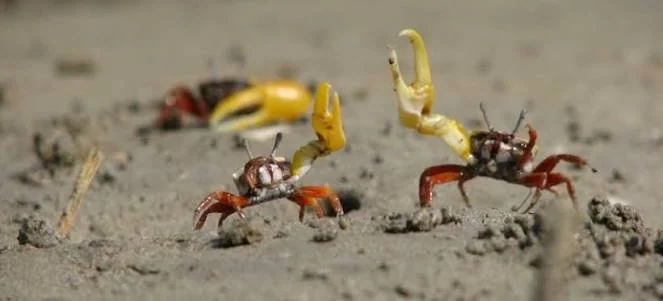
A welcome wave or a threat to step back?
Let me introduce you to the Mexican fiddler crab (Leptuca crenulata) and his big personality. His little body is barely an inch wide, but the claw he’s waving is about twice that, and his waving makes him look like a fiddler sawing away at his instrument, earning the species its name, the "fiddler crab." Yet he’s not waving hello, he’s trying to threaten you away from eating him, furiously waving his one big claw to make himself look as enormous and menacing as possible. While it may not work on you, it does a fair job of keeping bird predators from swooping down to grab a crab dinner.
If the male crabs see that you (or a gull) are still approaching despite their furious waving, they will signal the whole colony to dive for cover, all disappearing at once into the mud holes they call home. There they’ll be safe from surface feeders like gulls and terns, but not from birds with long probing beaks like herons or egrets. Which is why the tiny crustacean’s burrows can be up to two feet deep. Especially if they want to attract a mate.
Lady fiddler crabs agree: Size matters
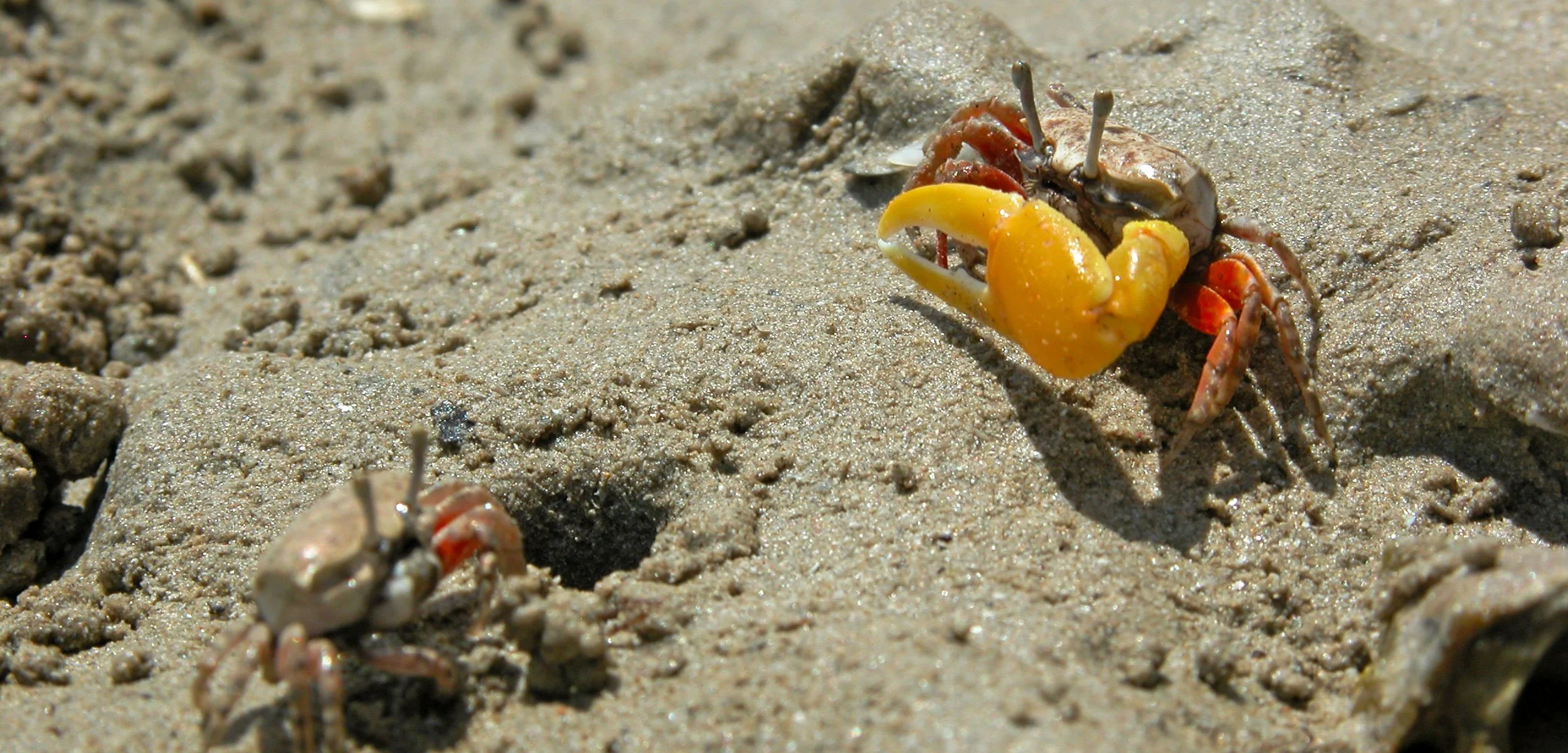
Male fiddler crab (to the right) seducing the female (to the left) by showing off his rather large appendage. (photo source here)
If the crabs haven’t spotted you and no predators are around, but they’re still all waving their one big claw in sync like a boy band on stage, you might have caught a rare sight of their mating dance. Females, who have small, equal-sized claws, are attracted to males with the biggest claws, most rhythmic waves, and deepest, sturdiest burrows. While the males stand beside their burrows waving “pick me, pick me,” females stroll through the colony to inspect their options. Click here for a video of this intriguing courtship display.
First, they check out the claw. Because size matters. A large claw typically means the male is not only strong and fights fiercely, but also since growing and carrying a heavy claw consumes a lot of energy and limits feeding eAiciency, it’s a reliable indicator of high genetic fitness and good health. (citation here)
If satisfied with the claw, females evaluate his dance moves. They look for males who wave their claws high, rhythmically, and vigorously, and sometimes the male with a smaller claw but a better groove wins the female.
Finally, lady crabs want to check out the digs, since this is where she will be raising her family. Even a strong male with great rhythm will lose out if his burrow is shallow or poorly built.
Life in the mud flats is one big slow picnic
Beyond the courtship drama, life as a Mexican fiddler crab is a constant race against the tide. These animals inhabit intertidal zones and their schedule depends on the moon and ocean currents. When the tide retreats, hundreds of crabs spill out onto exposed mudflats to feed before the tide returns to its high point.
For male fiddler crabs, feeding is complicated. Imagine trying to eat dinner using only one hand while supporting your other hand that’s as big as your whole body and half your body weight. That is the daily reality for a male Leptuca crenulata. Females use both small claws to scoop sediment into their mouths, making them twice as efficient. Males must work twice as hard to get the same nutrients, and they must constantly scoop mud into their specialized mouthparts with their single small claw. Inside their mouths, microscopic hairs filter out nutrient-dense algae, microbes, and decaying plant matter. Once processed, they discard the clean sand into tiny round pellets. If you see thousands of tiny mud balls surrounding a hole, you've found a fiddler crab address. (click here for a fun video, up close and personal with a fiddler crab)
When the tide rolls back in and the picnic’s over, the crabs retreat to their burrows in enough time to cover them. To prevent their homes from caving in or drowning them, they drag wet mud down to plug the entrance. They seal themselves inside a water-tight air pocket until the ocean recedes and the coast is clear to come out again.
Fiddler crabs are essential to healthy estuary ecosystems
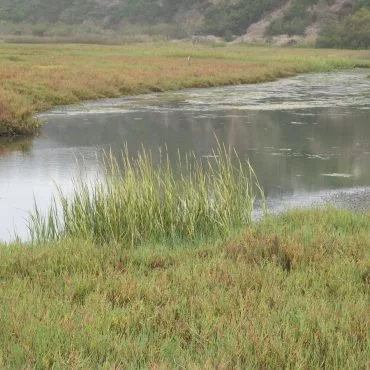
Marsh plants at Estero Punta Banda rely on the aeration provided by fiddler crabs (photo source here)
Leptuca crenulata is a keystone species in the ecosystems of Baja and Southern California estuaries. The entire salt marsh communities rely on their daily activities to stay healthy. By constantly digging and remodeling their extensive networks of burrows, fiddler crabs act as natural aerators. Without these tiny excavators, intertidal mud would become dense, compacted, and devoid of oxygen. Their churning of the mud introduces oxygen deep into dense, toxic sediments that would otherwise suffocate plant roots. This aerating process allows coastal marsh plants to thrive, stabilizing the shoreline against erosion.
When the tide rolls back in and the picnic’s over, the crabs retreat to their burrows in enough time to cover them. To prevent their homes from filling with water they plug the entrance with mud, sealing themselves inside until the ocean recedes and the coast is clear to come out again. Inside their burrows they have built a chamber that retainsenough air for them to wait out the tide cycle.
Like all crabs, fiddler crabs have gills to breathe underwater. Fiddler crabs are semi-aquatic, so along with gills they have adapted little “pseudo-lungs” to breathe air, as long as their gill membranes stay hydrated. You might wonder though, if fiddler crabs have gills like fish, why do they need air in their burrows? Good question! It’s because, unlike fully aquatic crabs that have soft feathery gills, fiddler crabs have stiff gills that prevent them from collapsing on land. So their gills aren’t as efficient in water as aquatic crabs, and if the crabs are submerged for too long they will drown.
You might also ask, if fiddler crabs drown when they can’t get air, why don’t aquatic crabs who live in the ocean full-time drown? Well, the gills of the full-time aquatic crabs are soft and feathery to absorb oxygen from moving water, while semi-aquatic crab gills are stiffer so they don’t collapse while on land, so they aren’t as efficient at absorbing oxygen from the water.
Threats to this vital species
Life in the intertidal zone is far from easy. Besides shorebirds and hungry raccoons, fiddler crabs face environmental threats. Coastal development, pollution, and marsh drainage directly threaten their habitat. Because fiddler crabs rely on specific mud density and tidal flows, even small changes in runoff can collapse their underground towns.
Losing them would damage the entire ecosystem. They serve as a vital link in the marine food web, converting microbial energy into food for fish, migratory birds, and larger mammals, also keeping marshes healthy through aeration. So the next time you walk past an estuary mudflat at low tide, pause and say hi when you see those thousands of tiny, waving arms waving at you. They are a sign of a thriving, hardworking ecosystem hidden beneath the mud.
But the estuary is in danger, and with it the fiddler crabs and all other life that teems in this important wetland.
Critical threats to our vital wetland
Estero Punta Banda is an internationally recognized wetland (a Ramsar site, covered on our website in July) and a crucial sanctuary that provides shelter to vast numbers of migratory shorebirds and marine life. The fiddler crab is among its most vital species, with an outsized role as an environmental bioindicator and keystone engineer of the marsh sediment. However, rapid urban growth and insufficient and degraded infrastructure are pushing the fragile ecosystem toward crisis.
The primary driver of the crisis is urban wastewater from the growing populations of Ensenada and Maneadero. During heavy rainstorms or all-too-frequent infrastructure breakdowns, millions of gallons of poorly treated or raw sewage flow down tributaries directly into the estuary. Because fiddler crabs inhabit the calm, shallow mudflats where water currents drop, these vital feeding grounds act as settling basins for pollutants, with heavy metals, chemical residues, and excess organic waste concentrating directly in the mud.
Cascading negative effects of wastewater pollution at Estero Punta Banda
The biological impacts extend far beyond the mudflats. Nutrient-dense sewage runoff triggers oxygen-depleting algal blooms, forcing crabs from their protective burrows and impairing their basic biological functions. When fiddler crab populations collapse or become contaminated, the entire food web is negatively affected. The crabs are a primary food source for dozens of bird species and juvenile fish. Furthermore, without the oxygenating and rejuvenating effects of their constant burrowing, the salt marsh mud degrades, unable to support plant or animal life.
For conservationists, Estero Punta Banda represents a clear warning: without significant investments in regional wastewater infrastructure, one of Baja’s most vital marine nurseries faces irreversible harm.
Be sure to take a look here for important GOOD news about the work being done to ensure Estero Punta Banda remains a healthy, thriving wetland for generations to come.