Slither into the wild world of serpents with our Species of the Month: the striking red diamond (Crotalus ruber), Punta Banda's most common scaly resident. While this local copper-hued beauty steals the spotlight, our gripping feature dives deep into the fascinating secrets of rattlesnakes everywhere.
RATTLESNAKE!! Or, How (and Why) to Peacefully Coexist with the Dreaded Danger Noodle
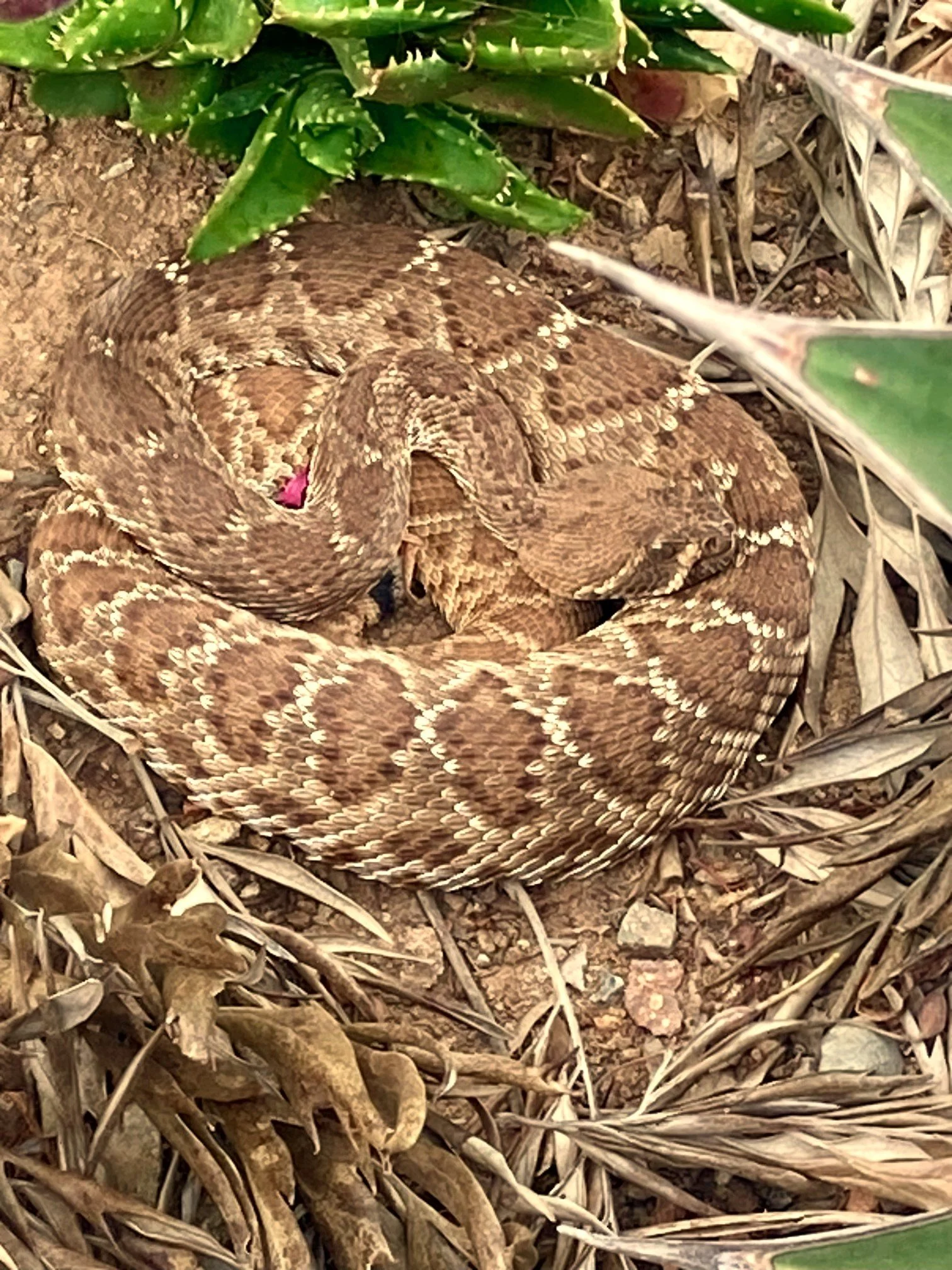
Red diamond rattler the author found in her backyard.
Rattlesnakes are pretty cool. And useful. Did you know that rattlesnakes are the reason why we have life-saving drugs like ACE inhibitors, anti-clotting medicines like Difibrase, and anti-cancer drug development like Crotoxin? Also advanced night vision for drones and military helmets, as well as AI algorithms for self-driving cars? And why we’re not overrun by damaging and disease-ridden rodents?
To many of us, rattlesnakes are terrifying. To others, they are beautiful, useful, and a textbook study in evolutionary elegance. Unfortunately, they are also among the most persecuted animals in North America. Even with a growing public consciousness of their ecological importance to healthy habitats, some people still kill them indiscriminately both in their yards and on the trail, in the misconception that rattlers pose a dangerous threat to life and limb. But it’s not your thinking brain that’s at fault. It’s your lizard brain. Our natural instincts are designed to recognize and be wary of these dreaded danger noodles, and there is good reason to avoid them. This article seeks to give you some of that interesting and important background, as well as some captivating Native American mythology, surprising facts about who gets bitten by rattlesnakes, and how to recognize which species you might come across at Punta Banda.
Your brain on snakes: Reacting before acting
We’ve been co-existing with pit vipers like rattlesnakes for 55 million years, since before humans were human. And still, nothing scares a hiker or gardener like hearing a sudden rattle nearby. Before you even have time to think, data shoots straight from your eyes to your amygdala, the brain’s emotional alarm system, completely bypassing your conscious thought. A surge of adrenaline hits. You freeze, your heart hammers, and your vision sharpens as you scan for danger. By the time your brain catches up and says “rattlesnake!” you’re already primed for fight or flight from this beautiful, dangerous, and woefully misunderstood creature. That’s instinct. But what you do next is based on what you know about rattlesnakes.
How Rattlesnake got his fangs (according to legend)
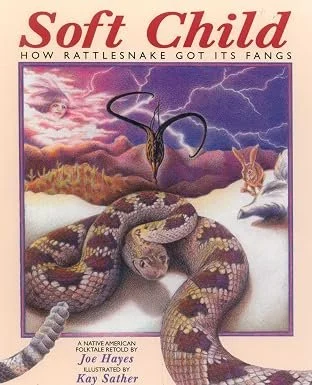
Book by Joe Hayes about the folk tale
In Native American myth, rattlesnake was once named “Soft Child” for its quiet nature and smooth, sinuous gliding. But humans and other animals taunted Soft Child, constantly whacking him with sticks, poking, and stepping on him. Exhausted and bruised, the snake appealed to the Creator, who felt sorry for Soft Child and so gave him fangs and venom to defend himself. The next creature to taunt Soft Child was bitten, thus introducing death into the physical world and erasing the name Soft Child forever.
Yet the core of the story remains. Rattlesnakes don’t seek to hurt humans. They would rather be left alone and only strike when hunting (good) or threatened (bad). It takes a huge amount of metabolic energy to create venom, a precious resource for the snake, and they sure don’t want to waste it on anything they can’t eat, including moi et toi.
The five T’s of rattlesnake risk
In California, a state with 39 million people, there are about 250 rattlesnake bites per year. In Baja California there are about 25 a year. But what’s interesting is who gets bitten (citation here). Turns out most bites are to the fingers and hands of young men aged 17-27, and more than a quarter of all bites involve alcohol, which is why toxicologists list snakebite risk as Testosterone, Teasing, Touching, Tequila, and Teenagers. 1 Snakebite fatalities are even more rare. There are a mere four snakebite deaths in all the United States per year, and in Baja California the average is fewer than one per year (citations hereandhere). You know what does kill us, though? Cars. In the US there is an average of about 45,000 traffic fatalities per year (citation here).
So why are we afraid of snakes and not cars? Good question.
The evolutionary arms race between snakes and primates
Venomous snakes and primates (including humans) have been evolving within the same habitats for 55 million years, mostly in the jungles of Africa where snakes were hard to see among the dense foliage. Only primates with the keenest eyesight and quickest reflexes could avoid being ambushed and eaten. And so the relationship between deadly snakes and vulnerable primates began an evolutionary dance that would influence the course of those two species forever. Because if something kills you repeatedly for millions of years, evolution will select for instincts that motivate you to see and avoid that thing. That’s the basic idea behind one current evolutionary theory known as the “snake detection theory,” which postulates that our ancient primate ancestors evolved to expand their visual pathways and develop bigger, faster brains capable of keen depth perception, detailed color vision, and rapid pattern recognition (citations here, here, and here). According to this theory, these adaptations led to the neural hardware required to help further evolve complex social interaction, tool use, and advanced cognition. In other words, the capabilities that make us human (citation here). There are of course other evolutionary theories, and most evolutionary biologists view brain size growth as a result of social complexity and dietary/foraging demands, yet snake detection theory is widely respected for explaining how 55 million years of dealing with venomous snakes helped create how our modern fear and vision circuits work in the brain.
By comparison, cars have been around for an evolutionary nanosecond, so humans have not had an opportunity to adapt to this danger (citation here). One might think this means in about 10 million generations, humans may evolve to better avoid this danger, but evolution doesn’t really work that way (biological evolution requires genetic variations for fear-of-cars that get passed down, which do not exist and are unlikely to exist in the future. Instead, humans rely on cultural learning, fast communication, and modern safety technology to avoid traffic hazards).
Keen eyesight and big brains aren’t the only things we can at least in part thank our ancient snake co-evolvers for, though.
Rattlesnakes are a high-tech biological masterpiece
Rattlesnakes are some of nature’s most sophisticated and high-tech creatures. From infrared night vision targeting, to high-speed acoustic warnings and precision strike mechanisms, their natural biological systems have inspired discoveries that are invaluable to modern life. So much so that many advanced military, medical, and computing technologies are based on rattlesnake tech. Things like built-in night vision, painless drug delivery, and even self-driving cars are possible today because of the study of rattlesnake biology. Development of the first ACE inhibitor blood pressure meds? They’re based on peptides in rattlesnake venom. Anti-clotting medications essential to many surgeries? Based on proteins found in rattlesnake venom. Breast and lung cancer treatments? Yes please. Early-stage clinical trials of rattlesnake venom-derived Crotoxin show very promising 83% growth inhibition in lung carcinomas and a 69% inhibition in mammary (breast) carcinomas. How about painless no-needle drug delivery? That too. Rear-fanged vipers like rattlesnakes use microscopic grooves along the outside of their teeth to draw fluid through surface tension. Bioengineers used this design to create microneedle patches that pull vaccines and liquid medications into the skin in seconds without a sting.
We could go on, like with temperature-sensitive “smart skin,” thermal night vision used in advanced military drones and helmet visors, and even using the rattlesnake’s 3D targeting systems in AI algorithms for self-driving cars and search-and-rescue drones that can navigate through thick smoke, fog, and pitch darkness. No doubt scientists will find many more miracles hidden in the rattlesnake’s complex biology, but let’s take a look at how these snakes get along with their main diet staple, the California ground squirrel.
Clever little ground squirrels outsmart hungry hungry rattlers
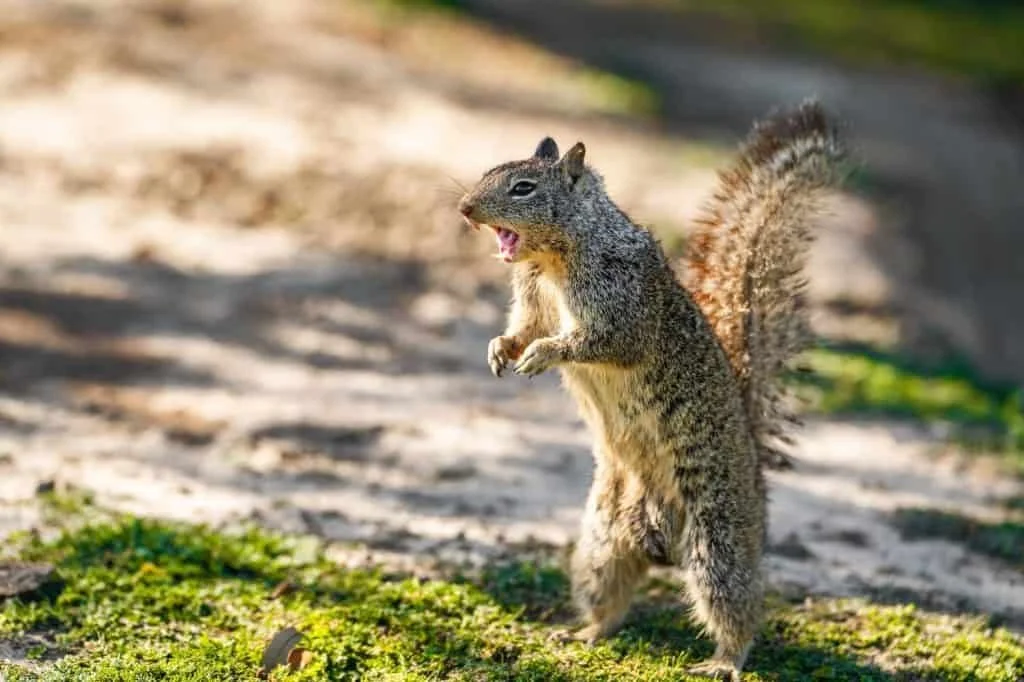
Ground squirrels, like humans, have been shaped by an evolutionary arms race with rattlesnakes
Humans haven’t been the only species shaped by an evolutionary arms race with rattlesnakes.
The other day I was feeding the quail in my Punta Banda garden when I looked down the steps to the lower garden and saw a California ground squirrel furiously wagging her tail at the entrance to her burrow; She recently had a litter of pups that were now “teens,” and I suspected there was a rattlesnake nearby or even in the burrow and mom was trying to lure it away.
This reminded me of my recent research while I was writing an article on ground squirrels (see article here). As described in that article, the tail wagging is a clever evolutionary ploy. When confronting a rattlesnake, the squirrel will deliberately pump extra blood into its tail, heating it up and aggressively waving it back and forth. To the snake’s heat-sensitive eyes, the sudden burst of thermal energy creates the illusion of a massive, menacing target, tricking the snake into backing down from an otherwise bite-sized meal. Interestingly, no other mammal has been discovered to use tail heating to deter snakes, only California ground squirrels, the species found locally around Punta Banda.
Getting to know your snake neighbors
Here at Punta Banda any rattlesnake you encounter is likely to be a red diamond rattler (Crotalus ruber), our Species of the Month. They are typically reddish-brown or brick red with a diamond pattern on their backs and black and white rings on their tails. The coloring and pattern help camouflage them within Punta Banda’s reddish clay and sandstone soils and leaf clutter, as in the top photo above from my garden. The red diamond species is one of the largest rattlers, but is also known among herpetologists as one of the calmer, less defensive species. These snakes prefer to rest among large boulders, heavy brush, and cactus patches. You may also see the Southern Pacific rattlesnake Crotalus helleri) locally, especially near trails, parks, coastal dunes, and developed coastal areas. This snake features dark, oval blotches on a gray, brown, or greenish-gray body. Neither of these species are aggressive, and will only strike if cornered, stepped on, or provoked. Remember that most rattlesnake bites are caused by people trying to taunt, move, or kill them.
Also know that some of what people repeat about rattlesnakes amounts to urban myth or old wives’ tales. Rattlesnakes will not chase you. They won’t attack unless provoked. Their first instinct is to blend in to its surroundings so you will walk by and leave it alone. The snake’s rattle is a polite warning telling you that you are too close, and to simply back away. And finally, there is no scientific evidence that rattlesnakes are undergoing an evolutionary shift to stop rattling or to strike without warning.
Make no mistake, a snake in the grass can still bite you. Unlikely, and less than one percent of bites are are actually fatal: citation here). But it could happen. So you always want to watch where you step, stick to trails and don’t traipse through brush that prevents you from seeing where your feet land, and if you find a snake near your house, use a snake stick to grab and move the snake a safe distance away or, better yet, call a snake handler with experience catching and moving rattlesnakes.
And the next time you take your blood pressure medication or use your smart phone’s camera to capture images at night, be sure to thank a danger noodle.
-written by Cindy Berryman