Give a Little Love to the Ground Squirrel
California Ground Squirrel (Otospermophilus beecheyi)
You see them scampering through fields, scurrying across roads, or perched atop bushes looking for predators (as they often do on the spit). And they maddeningly dig in your garden. I’m talking about ground squirrels. Specifically the California ground squirrel, Otospermophilus beecheyi.
You may think of them as bothersome pests or even mistake their hole-digging handiwork for other common burrowers, like my Punta Banda neighbor did a few weeks ago. She told me she had moles, and asked me to take a look. I’m a conservation biologist, not a pest exterminator, so I don’t always have the same opinion of the animals that annoy most people, but I was happy to check it out for her.
She pointed to several round, open holes in the ground, and I immediately saw they were made by California ground squirrels, whose burrow openings are distinct from those of other local burrowers. Mole holes, for example, often show raised, linear ridges across the ground from their shallow tunnels and occasionally leave conical mounds with no visible openings. Another backyard burrower, the pocket gopher, creates crescent-shaped mounds around their burrows and plugs the burrow entrances.
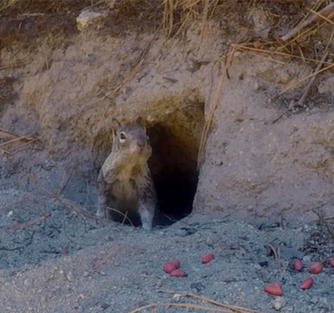
Their burrows have roundish, open entries
Any round, open burrow entrance several inches in diameter on Punta Banda is most likely created by ground squirrels. But that doesn’t always mean a ground squirrel lives there. Abandoned burrows are often taken over and remodeled by mice, lizards, burrowing owls, and even coyotes.
Fun Fact! Grocery Bag Cheeks
California ground squirrels are wild grocery shoppers with built-in tote bags, their expandable cheek pouches where they stuff seeds, nuts, and other goodies. While they mostly stick to a plant-based menu—grains, leaves, stems, and nuts—they’re not above a little protein boost. If an unsuspecting insect crosses their path, it might just become lunch. They carry their stash to the safety of their underground pantries where they can eat in peace, safe from predators, or store for a rainy day.
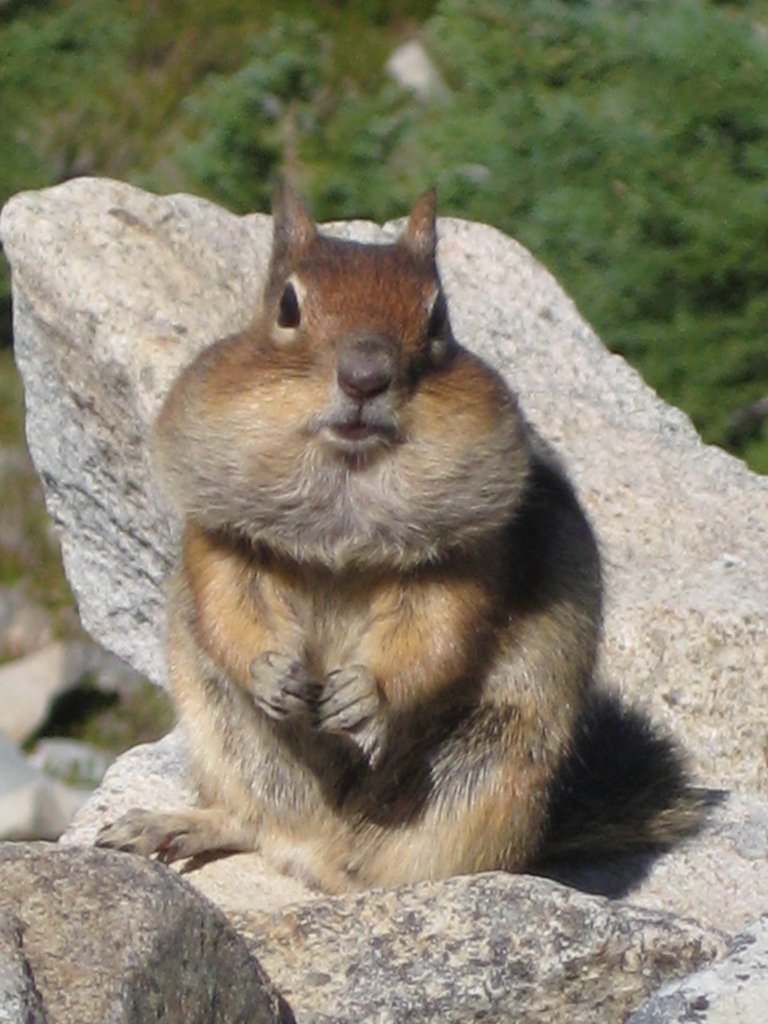
Grocery bag cheeks
Fun Fact! Rattlesnake and Squirrel Arms Race: like Coyote and Roadrunner
One of the California ground squirrel’s most formidable enemies is the rattlesnake, and over the years the squirrels have developed remarkable defense mechanisms. These behaviors and physiological traits highlight a long evolutionary arms race between predator and prey (like Coyote and Roadrunner), making their interaction one of the most studied examples of coevolution in North American ecosystems.
Adults in a colony of ground squirrels will often mob rattlesnakes by kicking dirt, biting, and making rapid movements to intimidate them. But most astonishing is what the squirrels can do with their tails! When threatened by a rattlesnake, they rapidly increase blood flow to their tails, warming them up significantly. This heat is invisible to humans and other species but detectable by rattlesnakes, which have specialized infrared-sensing pits to locate warm-blooded prey. When the squirrel waves its heated tail, the rattlesnake perceives a much larger and hotter target than the squirrel’s actual body size. This creates confusion because the snake relies heavily on thermal cues for striking accuracy. The exaggerated heat signal makes the squirrel appear more threatening or harder to target, often discouraging the snake from attacking. Interestingly, squirrels only heat their tails when facing rattlesnakes, not other predators, showing how specialized this adaptation is.
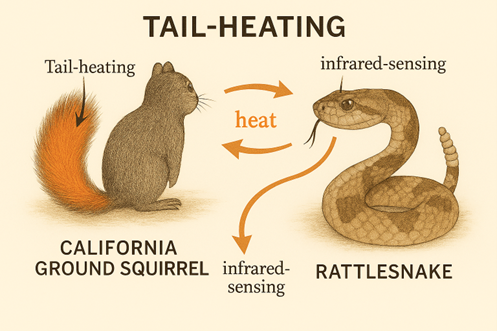
Squirrel Outfoxing a Rattlesnake with its heated tail.
Another adaptation California ground squirrels have developed through the arms race is venom resistance, allowing adults to survive bites that would be fatal to many other animals.
As if that wasn’t enough, California ground squirrels also chew up the shed skins of rattlesnakes and then lick their fur, masking their own scent! This tactic is handy when the squirrels are sleeping in their burrows, hence can’t swish their tails. Rattlesnakes passing by are thought to miss the squirrel’s scent altogether and perhaps think another snake is occupying the burrow. Watch a fascinating video of the squirrels and their snakeskin trick by clicking here.
Another adaptation California ground squirrels have developed through the arms race is venom resistance, allowing adults to survive bites that would be fatal to many other animals. As if all that wasn’t enough, California ground squirrels also chew up the shed skins of rattlesnakes and then lick their fur, masking their own scent. This tactic is handy when the squirrels are sleeping in their burrows, hence can’t swish their tails. Rattlesnakes passing by are thought to miss the squirrel’s scent altogether and perhaps think another snake is occupying the burrow.
A Keystone Species!
California ground squirrels are what ecologists like me call a keystone species. That means they play a critical role in maintaining healthy or balanced ecosystems, including providing food and shelter for other wildlife species, and maintaining healthy soil.
Ground squirrels are a vital source of food for mammals such as coyotes, bobcats, and foxes, as well as raptors like hawks, eagles, and owls, which rely on squirrels for a substantial portion of their diet. They’re also one of the few small mammals in western ecosystems that are active during the day (i.e., diurnal, in contrast to mice and other small mammals which are nocturnal, only going out at night). This makes them a vital prey source for diurnal predators. As a biologist who did many wildlife surveys in my lifetime, I found that the presence of ground squirrel burrows was often a sign of good habitat for rare and endangered species such as western burrowing owls (one of the few owl species that’s active during the day), Swainson’s hawks, and San Joaquin kit fox. Interestingly, the endangered San Joaquin kit foxes have switched from being nocturnal to adopting diurnal hunting strategy in the northern part of their range where ground squirrels significantly outnumber nocturnal prey. California ground squirrels are also an important food source for other hawks, coyotes, bobcats, and mountain lions. These squirrels are a vital prey source for a wide variety of wildlife, making them an important link in the food web of California ecosystems.
The ground squirrel’s burrows are attractive to many other local home-seeking species, including snakes, foxes, mice, coyotes, and badgers. They’re particularly vital for populations of species who are unable to dig their own burrows, such as the western burrowing owl. In fact, a program developed by the San Diego Zoo Wildlife Alliance is “harnessing” the California ground squirrel to help restore dwindling populations of our threatened native burrowing owls. Scientists are capturing squirrels in areas where they aren’t wanted and relocating them to grassland habitats, where their industrious burrow building is creating nesting sites for the owls. This is a pilot program, and I certainly hope it works!
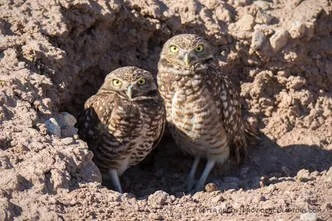
Burrowing owls using a California ground squirrel burrow
But burrow building and providing food for predators aren’t the ground squirrels’ only contribution to healthy habitats. Their prolific digging loosens and aerates soil, encouraging plant growth and diversity. Importantly, they help restore degraded grasslands that have been invaded by thick, nonnative thatch grasses, which native species cannot survive in.
The ecological role of the California ground squirrel underscores their significance beyond being a common rodent—they are a keystone species that influences predator abundance, biodiversity, and overall ecosystem balance.
Can’t live with ‘em, can’t live without ‘em
As advantageous as ground squirrels are to healthy habitats though, farmers, ranchers, and homeowners aren’t as enthusiastic about these pint-sized critters as conservation biologists like me are. They can devour crops, chew roots, gnaw irrigation pipes, and even undermine hillsides and building foundations with their burrowing. And their burrows are an injury hazard for livestock that step on their burrows.
Unfortunately, in addition to being vital to healthy ecosystems, some may consider California ground squirrels, “varmints” (not to be confused with their cousins the yellow-bellied marmots). I used to know an elderly couple who had a ground squirrel that was constantly getting into their house and stealing food from the pantry. It was always a source of amusement when the squirrel would peer in their window and the old woman would yell about that damn rascal coming ‘round again. But these varmints can cause damage that isn’t always as entertaining. Their extensive burrow systems undermine soil stability, leading to erosion and weakening of levees, irrigation canals, and even building foundations. They also feed on crops such as grains, nuts, and vegetables, reducing yields and contaminating stored feed. Burrows can also interfere with farm equipment and create hazards for livestock by causing injuries from holes in pastures. And like moles and gophers, ground squirrels can be pesky invaders of your home gardens
Balance
Now that you know how fascinating these critters are, and how vital to healthy ecosystems, you likely understand the importance of balancing between conserving them and controlling them as pests. Effective management means reducing conflicts without erasing their ecological benefits—using targeted, humane control methods and preserving habitat where possible.
-Written by El Berryman
-Editing by Cindy Berryman