Eurasian Collared Dove: Invasive Like Us
I was trying to decide which local species to feature this month as we enter the holiday season. I landed on the dove - a universal symbol of peace. And no matter how you honor the season, you just can’t deny that “peace on earth” would be very cooo-l (see what I did there?). So come with me on my journey of making peace with an invasive species, the Eurasian collared dove. Let’s start with a species description, then follow the spread of this avian colonialist across the planet.
Eurasian Collared Doves vs. Common Pigeons
Eurasian collared doves (Streptopelia decaoctois) are likely the most common dove species you’ll see in the Punda Banda area. That is, not including rock doves (Columbia livia), customarily known as common pigeons, but they don’t count as doves in my book. In fact, common pigeons are generally reviled as pests. Both the Eurasian collared dove and the common pigeon colonized the Punta Banda peninsula after spreading across Europe and the United States, and both like to live around human habitations. You can tell the difference between Eurasian collared doves and common pigeons by the pale, gray buff or pinkish gray of the dove, compared to the pigeon which comes in various shades from gray to white to brown to black, often with mixed colors in a flock. The necks of pigeons have an iridescence that shifts in the light from purple to green. And of course, the Eurasian collared doves are best distinguished by their collars - a narrow black crescent on the nape of the neck. These doves are also slimmer than the stocky pigeons. Soundwise, pigeon wings whistle or whir upon take-off, unlike the silent wings of Eurasian collared doves. The Eurasian collared doves make a three noted call with an emphasis on the second note (coo-COO-cook) while the pigeon has a deeper rumbling two noted call (rooo-rooo-rooo-rooo-rooo). Cornell Labs have a recording of a Eurasian collared dove here, and Ebird has a recording or the common pigeon here (The second recording is best. It also includes wing songs).
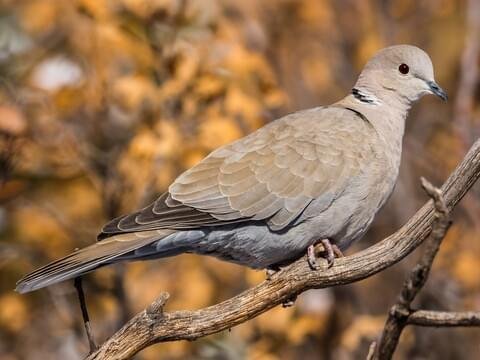
Eurasian Collared Dove, courtesy Cornell Labs

Pigeons with green and purple iridescence (by Ingrid Taylar)
Asian Origin and Balkan Reverence
Eurasian Collared Doves didn’t always live here, as you may have figured out by their name. The species is thought to have originated around 9.8 million years ago in southern Asia, including India, Sri Lanka, and Myanmar, and were limited to this area for millions of years until they began to spread northwestern into Turkey and the Balkans. It’s unknown exactly when these doves arrived in the Balkans, but they were common there by 1800 during the Ottoman Empire.
Eurasian Collared Doves thrived in the towns and cities of the Balkans during the Ottoman Empire because the Muslim population there protected them. Muslims created nest sites around their houses, and in certain areas the punishment for killing a dove was a two weeks in prison. But when most Turks were forced to leave their Balkan territories after defeat in the Russo-Turkish War in 1878, the Eurasian collared doves lost their protectors and their numbers dropped precipitously, perhaps due to hunting. The doves later made a comeback and had reached their former numbers in the Balkans by 1930. It was then that their range began to explode across the map, expanding throughout Europe in a relatively short amount of time.
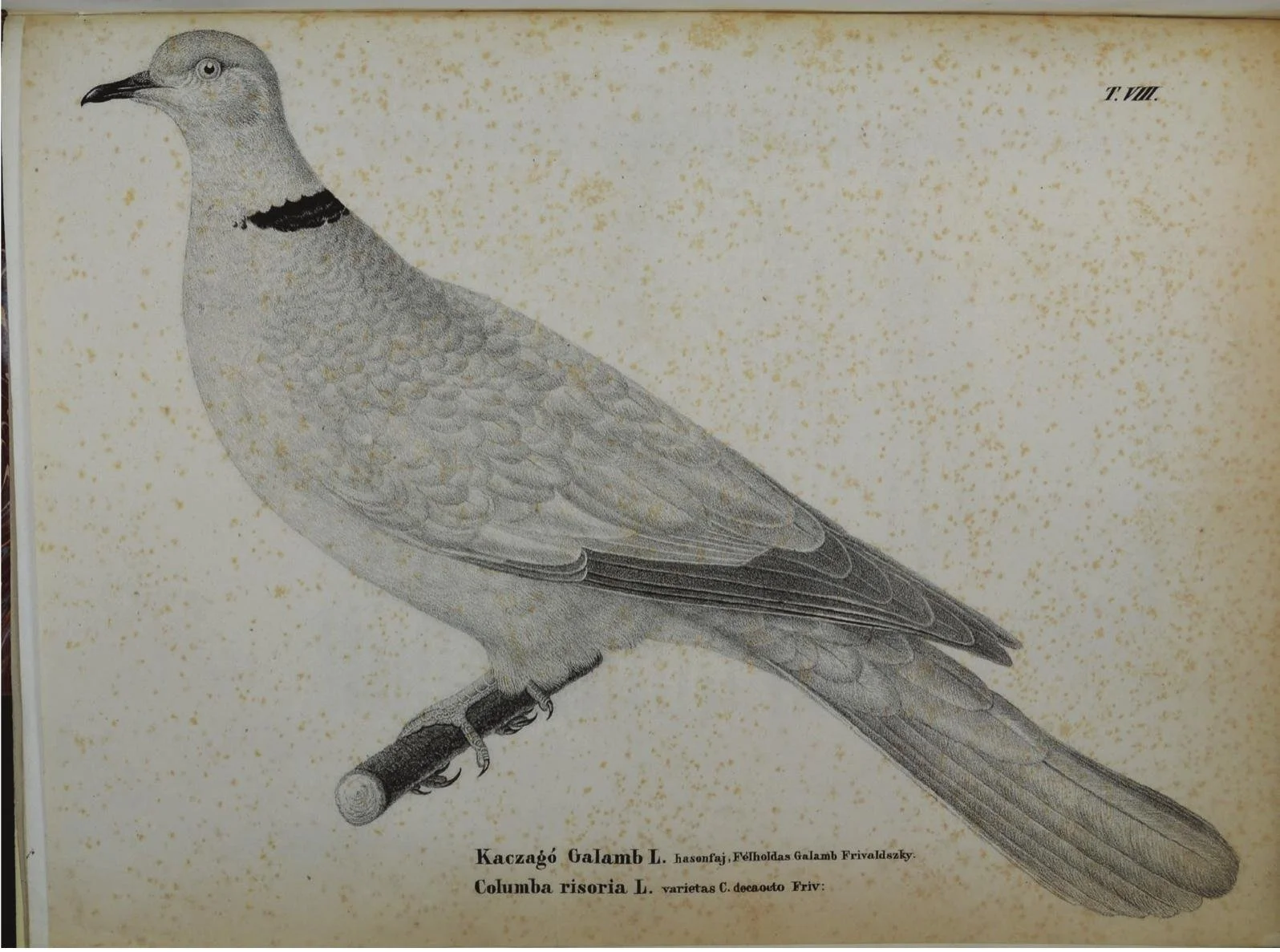
An illustration of the Eurasian collared dove by J. F. Naumann accompanying the species' type description by Frivaldszky in 1838 (in the London Natural History Museum). A species’ type description is a formal scientific document that describes in detail a newly discovered species and its unique characteristics. This description is regulated by international codes of nomenclature and includes a "type specimen" or illustration that serves as the permanent, physical reference for the new species' name
North American Invasion
Eurasian collared doves first arrived in the New World in 1974, when fewer than 50 individuals escaped captivity in the Bahamas. By the 1980s they had spread to Florida, and their spread across the continent continued. In Baja California, they weren’t recorded until 2000, and the first confirmed breeding was in Catavina in 2004. It’s rather hard to believe that this species, so abundant on the Punta Banda peninsula now, has only been in Baja for about 25 years. Compare this with common pigeons who have been here since the 1700s.
Invasive Eurasian Collared Doves vs. Native Mourning Doves
Before the local invasion of Eurasian collared doves, the most common local doves were mourning doves. Although you’re more likely to see the invasive Eurasian Collared Doves, you can still see the native mourning doves in less developed areas. The Mourning Dove lacks a collar and is smaller than the Eurasian Collared Dove. The coo of the Mourning Dove is slow, breathy, and mournful, hence its name (Coo-OO0-ooo-oo-ooo: Cornell Labs have a recording here, including wing sounds). The Asian Collared Dove’s coo is more persistent, impatient, and repetitive. The Mourning Dove is a native species, and dear to my heart as its cooing was the soundtrack for some of my earliest fond memories: drowsing on summer afternoons in the meadow or under the pepper tree, or rambling over fragrant sagebrush hills now long gone.
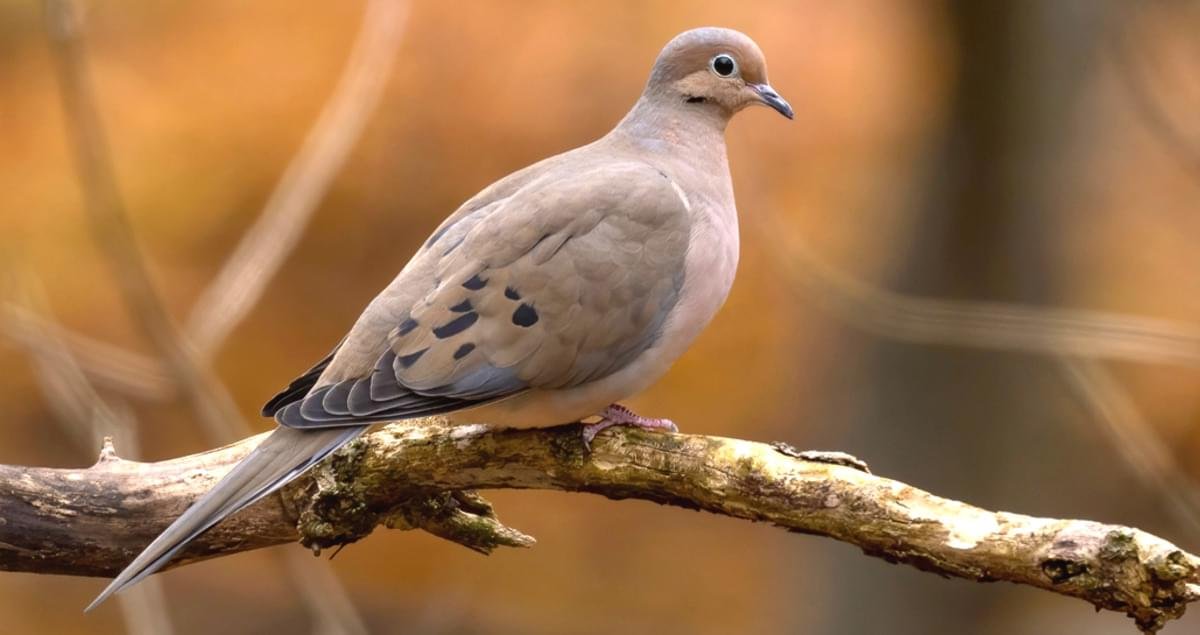
The Native Mourning Dove
Invasive Like Us
When Eurasian collared doves began invading California in the early 2000s, I held a grudge against them. Non-native species are generally frowned upon by conservation biologists such as myself. Besides, their calls were replacing the soothing nostalgic coos of the mourning doves. Then I had a shift in perspective one morning soon after I retired, as I lounged about on my sun drenched deck while sipping coffee, gazing at a Eurasian collared dove perched on an electric wire. She was beautiful, and her cooing was nearly as soothing as soothing as the mourning dove’s when I didn’t pile on my distaste for invasives. It occurred to me that humans have likely had a far more negative impact than Eurasian collared doves on mourning dove populations. In fact, the evidence is inconclusive whether Eurasian collared doves actually outcompete mourning doves, or Eurasian collared doves simply prefer developed areas more than mourning doves do. Humans are replacing mourning doves through urban creep, while urbanization is favorable to Eurasian collared doves. This is true for the pigeons too, as they favor developed areas. I might hold a grudge against the species as a whole, whether it be humans or Eurasian collared doves or common pigeons, but can still appreciate the individual who can’t help where they were born. Maybe pigeons not so much, but there are redeeming qualities even for them - just ask the old lady and children in Mary Poppins singing “Feed the birds.”
So I, for one, have made peace with Eurasian collared doves, forgiving their heritage and recognizing our commonality as invasive species.
Peace Out, El Berryman
(References available upon request)