California Scrub Jay: Typical birdbrain or “feathered ape”?
Next time someone calls you a "birdbrain," you might say thank you. Because while most people think birds aren't very smart, scientists are discovering that some birds have mental powers that rival our own. In fact, one bird you probably know pretty well is a downright bird genius.
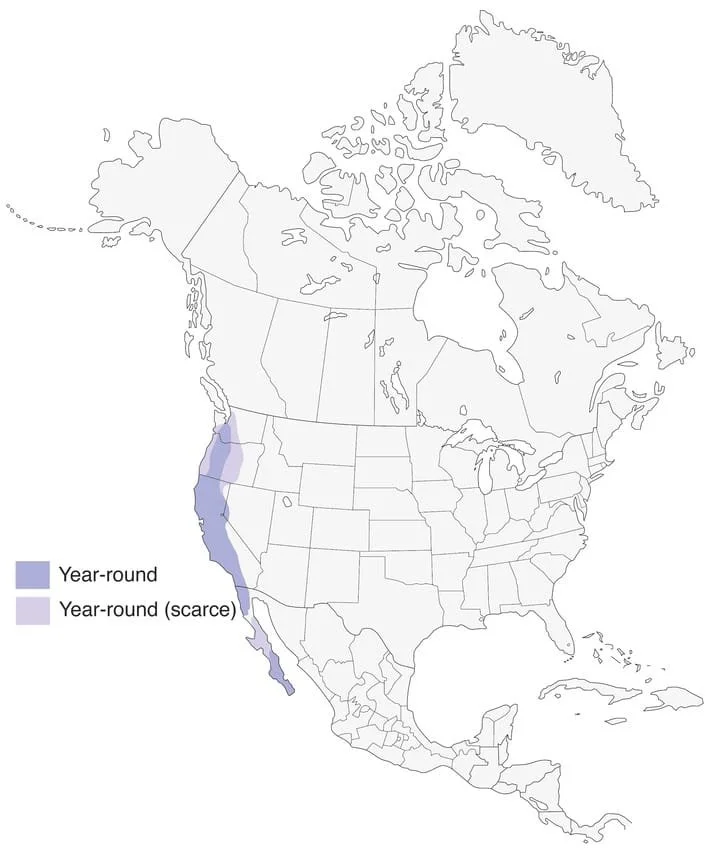
Range of the California scrub jay. Cornell University
That’s our own California scrub jay (Aphelocoma californica). With their bright blue wings and tails, soft gray backs, white undersides, and a loud, bold, raucous nature, they’re hard to miss around Punta Banda, or anywhere else from Washington state to Baja Sur.
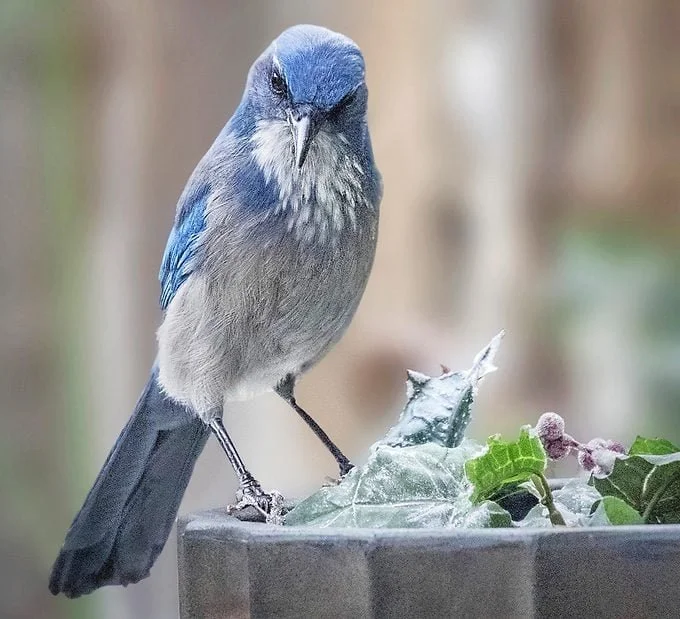
Brainy bird
But behind those beautiful blue feathers lies one of the smartest brains in the animal kingdom. Scrub jays are members of the corvid family, which includes crows and ravens, birds so smart that some scientists call them "feathered apes."
That’s because their mental capabilities, problem-solving skills, and social intelligence match or even exceed those of great apes like chimpanzees. The nickname applies to the whole covid family, but California scrub jays were the catalyst for not only the moniker, but the truly seismic shift in thinking about bird brains.
California scrub jays plan for the future
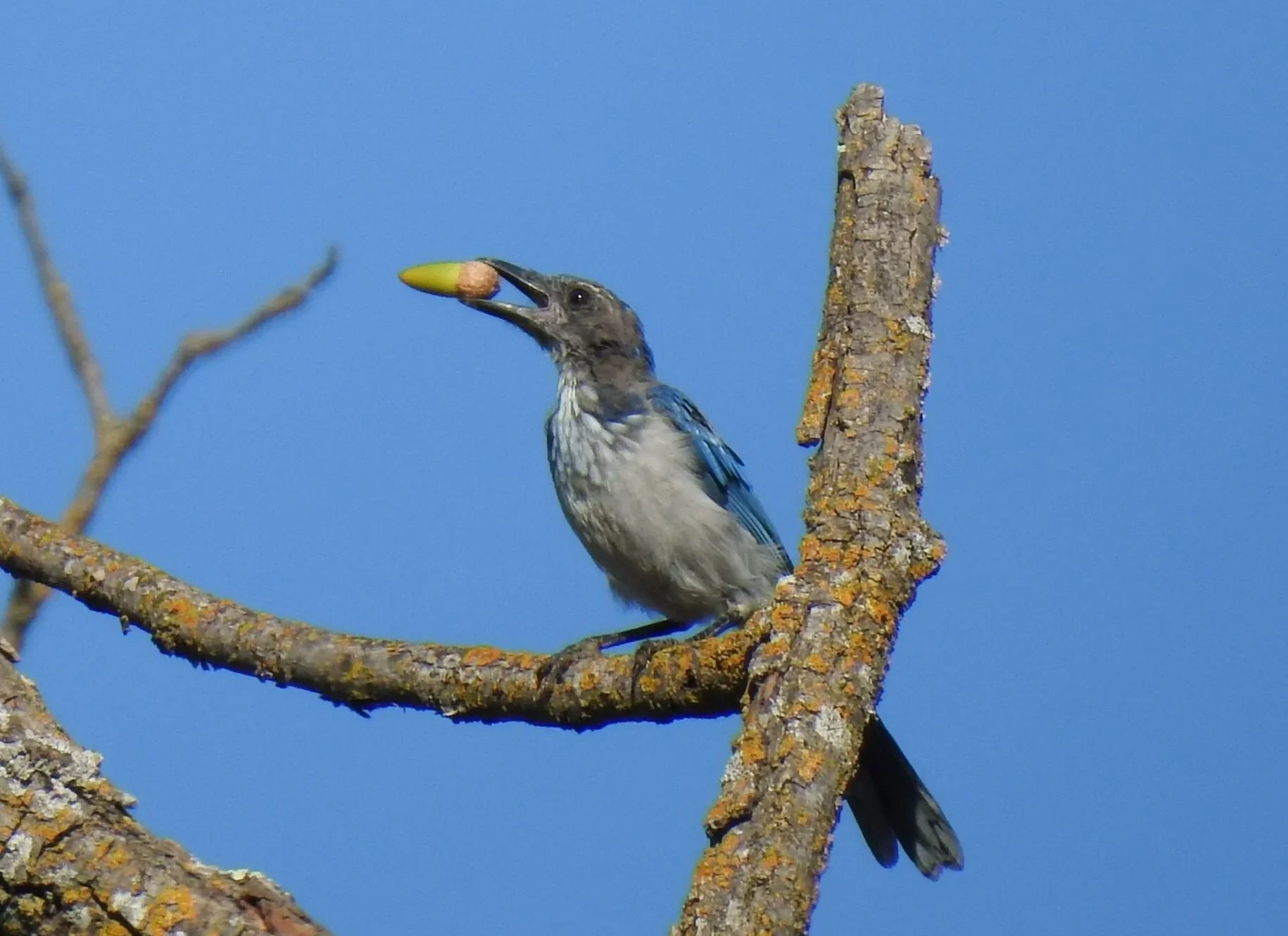
Storing acorns
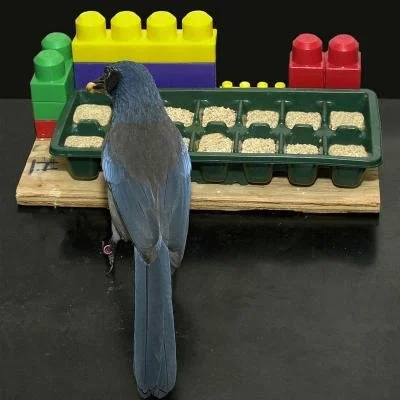
A landmark Cambridge study demonstrated that jays can plan for tomorrow by caching food in specific rooms based on past hunger. The experiment demonstrates advanced cognitive planning abilities in the Eurasian jay.
Scientists used to think that humans were the only animals that can think about the past or the future, and specifically, to remember the past to plan for the future. But now we know that scrub jays prepare for winter the same way our ancestors did, by storing food for winter’s lean times.
If you’ve ever fed peanuts to scrub jays, you probably saw them grab a peanut with their powerful bill, fly away out of your view, then return a minute later for more peanuts. It’s not because they’re fast and super hungry. It’s because they are hiding their cache by digging holes with their beaks, dropping the peanut, pounding it deeper, and refilling the dirt over it. Because they have amazing memories, they remember exactly where they hid almost every single one, hiding up to 5,000 or more peanuts or acorns or other food to last a season.
Playing mind games
Remarkably, scrub jays engage in thinking about risk management, caloric potential, spoilage calculations, and counter-deception. You may see the birds picking up peanuts or acorns and seeming to weigh them, dropping the light ones and choosing another heavier one, thus judging caloric content. Then, since keeping their food stash secret can be a matter of life or death, and neighbor jays are always watching to pilfer a free meal, the birds engage in elaborate psychological warfare. If a scrub-jay senses a rival watching it bury food, it performs an elaborate fakeout, digging a hole, pretending to drop the food in, and carefully patting the dirt back into place. Then they’ll nonchalantly fly away with the food hidden in their sublingual pouch, a pocket just under the tongue. This evolutionary adaptation acts as a hidden backpack, letting the bird carry several peanuts or acorns without being obvious about it.
Likewise, scrub jays are also able to remember that their cached insects or other perishable food must be eaten first, before it spoils. This requires an active mental tracking of the expiration timeline, something beyond the mental capabilities of most other animals or birds.
Equally interesting, these birds have a remarkable ability to overcome fear instinct to learn trust and recognize individual humans. To take food from your hand, a scrub-jay must suppress its natural fear impulse, calculating potential threat against potential caloric value. A scrub jay may not find it worth the risk to take a sunflower seed from your hand, but a peanut? Totally worth it! Maybe not at first try, but over repeated exposures the birds will actually learn to recognize you, trusting you are no threat.
What birdwatchers should know about the California scrub jay
When you spot a bird, stay a minute and watch their behavior, because bird watching is as much about getting to know the species (and individual) as it is about checking a box. The scrub jay’s behavior is particularly fascinating. Here are a few traits birdwatchers should be able to recognize in the field:
Social Dynamics and Audacity: Unlike more secretive jays like forest-dwelling Steller’s jays or Woodhouse’s scrub jay of the interior Western states, California scrub-jays are bold, curious, and highly vocal. They frequently push themselves to the front at backyard feeders, and use a harsh, rising "shreep" call to sound alarms or defend territory.
Complex Foraging Intellect: Watch their ground behavior closely. If you see a jay repeatedly picking up an acorn, shaking it, or frantically shoving it under leaf litter, you are witnessing complex spatial planning. Because they remember exactly who is watching them hide food, a jay that spots you observing its cache will often return later to dig up and move the prize to a private location.
Mated Pair Cooperations: California scrub-jays form monogamous pairs that stay together year-round, defending their territory as a unified team. Unlike species that rely on large family flocks, these pairs work in tandem; while one jay forages on the ground or hides food, the other often acts as a sentinel from a high perch, scanning the area for predators like Cooper's hawks.
Key Characteristics
Appearance: Medium-sized (11–12 inches long), long-tailed, and crestless. Both males and females look identical.
Diet: Omnivorous. They eat insects, berries, lizards, nuts, and are especially fond of acorns, which they actively harvest and bury.
Habitat: Found along the Pacific seaboard, from Washington state all the way down to Baja California, Mexico.
Lifespan: These resilient birds can live up to 15 years in the wild
Give a round of applause to the California scrub jay
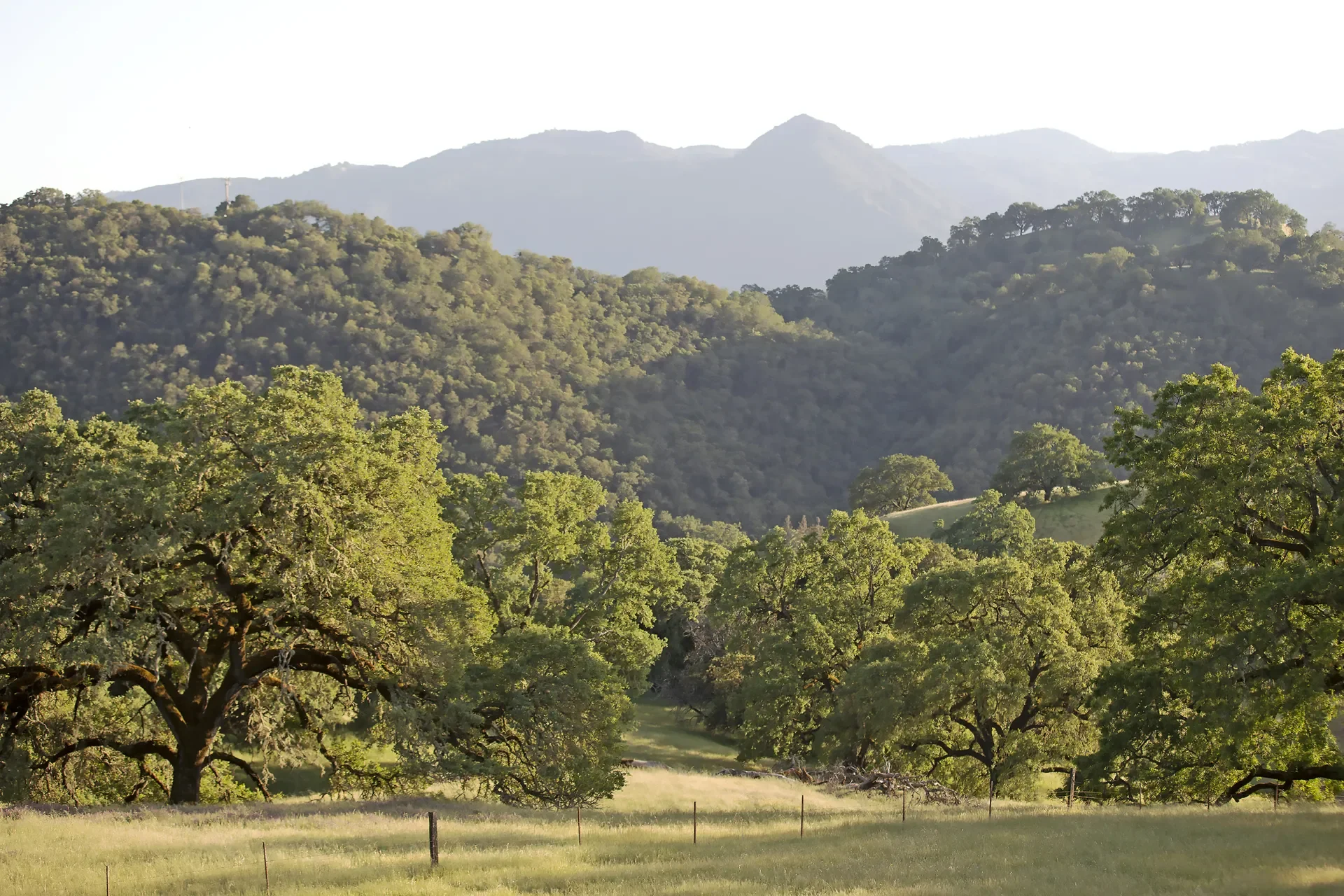
Scrub jays help maintain oak woodlands
We owe oak landscapes in the west to the industrious scrub-jay. By burying many more acorns than they ultimately use each fall, these clever birds are helping to plant the next generation of trees, continually replenishing our woodland ecosystems one misplaced or forgotten cache at a time.
The next time you see a California scrub jay, take the time to introduce yourself and they’ll soon be literally eating out of your hand. Here’s how:
1. Create a unique visual trigger by wearing the same distinctive piece of clothing each time you approach (bright hat, colored shirt, etc).
2. Keep your face visible and don’t wear sunglasses.
3. Create a unique audio cue like a call or whistle to use just before offering food.
4. If the jay is close enough, make brief eye contact, toss a peanut (a jay favorite!) halfway between, then take two steps back and look away. This way you’re recognized as a food source, not a hunter.
5. Gradually reduce the distance until the jay will take the peanut from right in front of you.
6. Once you reach that level, next time you can hold the peanut flat in your outstretched hand. Look slightly away, then let them swoop in and grab it with their tiny but adept claws.
Once you gain a California scrub jay’s trust, the bird will remember your face for years, even after long absences.
Totally worth it!