Why is the Pacific sand dollar so eccentric?
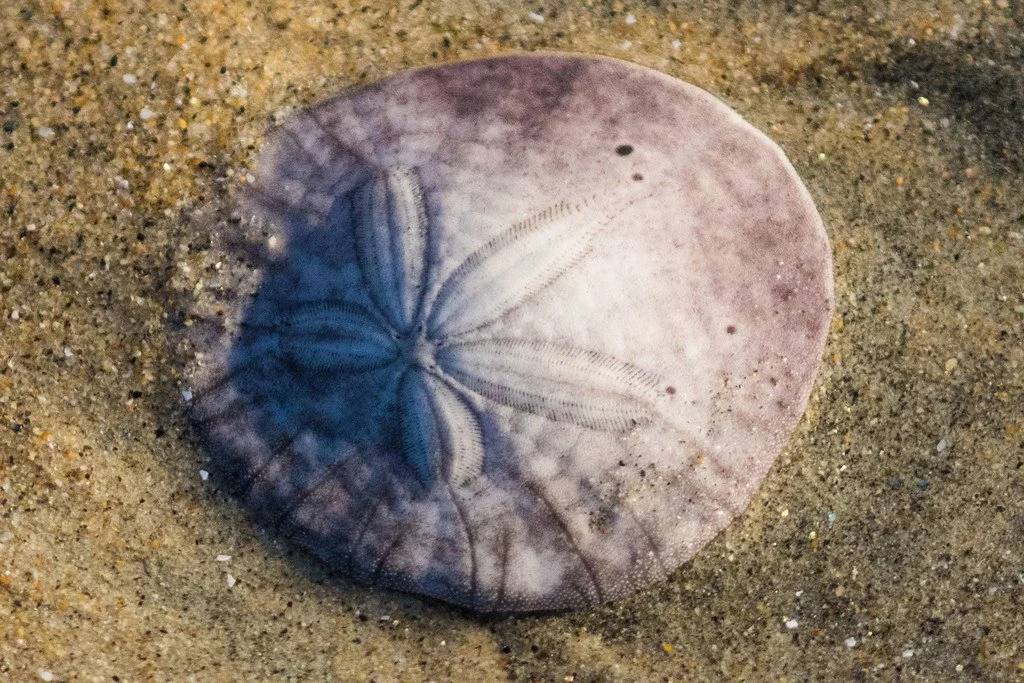
Pacific eccentric sand dollar shell washed up on the beach
Take a walk on the shoreline of Bahia Todo Santos and you’re likely to see charming little sand dollars washed up along the tideline. These smooth, flat, bleached-white discs with a five-point star etched on top are the skeletons of a surprisingly complex sea creature. Not just any sand dollar (though they are all complex), but the Pacific eccentric sand dollar (Dendraster excentricus). (Or in Spanish, Galleta de Mar Excentrica.)
Adapting to a hard life
They live in dense colonies of up to 600 per square meter just offshore, in the shallow, turbulent waters of the surf zone, where they are using every evolutionary strategy they’ve got to stay in one place against the ever-shifting flow of water. It’s not easy being a sand dollar, weighing just around 20 grams and being buffeted by tides and currents and crashing waves.
And that’s where our Pacific sand dollars are a bit off-center. Literally. You probably know sand dollars by the distinctive five-pint star on the top of the skeleton. If you compare the skeleton of a Pacific sand dollar to any other found around the world, you’ll see that the star is off-center, compared to the others where it is located precisely at the center. By being off-center (literally eccentric) shifts weight to that side, acting as ballast against the currents.
Evolutionary superpower
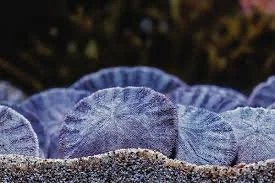
Standing vertically
This clever evolutionary trick allows the Pacific sand dollar to stand vertically in the sand, its mouth facing into the current to maximize feeding, trapping food in their tiny, fuzzy spines and moving it from spine to spine like a bucket brigade to reach the
Specialist spines (millions!)
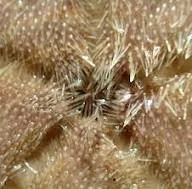
Mouth
Live sand dollars are covered in a dark, dense coat of millions of tiny, velvety spines. Each one is attached to the shell by a tiny ball and socket joint, allowing the spines to move in various directions for various purposes. Tight networks of protective shoe spines shield its surface from heavy debris, while sharp frill spines line its outer rim to help it saw into the sediment. When food drifts past, microscopic, hair-like miliary spines coated in mucus trap the particles. Beating hairs called cilia then act like an organic conveyor belt, sweeping the food down dedicated grooves toward the mouth located on its underside. If waves become too rough, they simply use their muscular ambulatory spines to flatten themselves out and burrow safely beneath the sand.
Breathing through their feet?
And that five-point star? It’s not just for ballast. Its primary purpose is for breathing. Look closely at the skeleton and you’ll see the star is made up of microscopic perforations. On a live sand dollar, little tube feet extend through these holes, absorbing oxygen from seawater and releasing carbon dioxide. Because the star pattern is shifted off-center on Dendraster excentricus, these breathing structures remain exposed to the open water column even when the lower half of the sand dollar is anchored deep in the mud.
From Aristotle’s imagery…
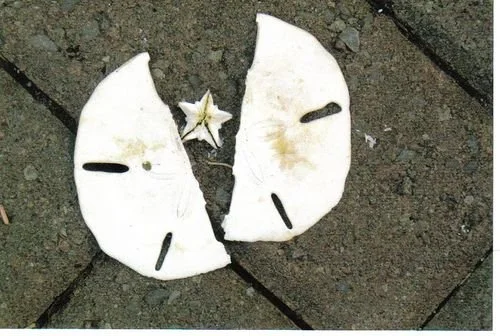
Have you ever picked up a sand dollar skeleton and heard it rattle inside? What you’re hearing are the skeletal jaw segments that remain after tissues decompose. The sand dollar’s jaw is a complex five-sided mechanism known as Aristotle’s lantern, first described by the man himself in his famous biological text, Historia Animalium (History of Animals), written around 2,500 years ago. Aristotle noticed that the five jaw segments are arranged in a shape that resembles an ancient lantern. The individual white, V-shaped jaw segments resembling miniature, winged birds in mid-flight.
….to Christian legend
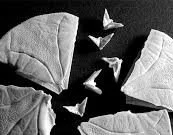
This striking natural phenomenon gave rise to a persistent Christian Legend of the Sand Dollar; interpreting the sand dollar’s markings as symbols of the life of Jesus Christ. According to the legend, the five-pointed star on the top of the skeleton represents the Star of Bethlehem that guided the Wise Men, while the outline of a poinsettia on the reverse side symbolizes Christmas. The five distinct holes or slits (lunules) in the shell are cast as reminders of the crucifixion wounds—four representing the nails driven into Christ’s hands and feet, and the fifth representing the spear wound in his side. Finally, the story concludes with a dramatic reveal: breaking open the hollow skeleton releases the five loosened jaw pieces, the “doves” that symbolize the spreading of peace, goodwill, and the Christian gospel across the world.
Guardians of the seafloor
The Pacific eccentric sand dollar is much more than a seaside souvenir. It is a vital ecological engineer. By constantly churning the sediment and filtering thousands of gallons of water, these vast underwater colonies reshape the seafloor, providing oxygen to buried microorganisms and serving as a crucial food source for crabs, sea stars, and bottom-feeding fish. Their presence is a direct indicator of a healthy, dynamic coastal ecosystem. The next time you find a weathered white shell on the shore, you are holding the legacy of a masterful vertical community that keeps the Pacific coastline thriving just beneath the waves.
-by Cindy Berryman