A Blue Dick by Any Other Name Would Taste as Sweet
Take an early April walk anywhere in the wild hills or mesas of Punta Banda and you’re bound to see charming little Blue Dicks (Dichelostemma capitatum), a pretty blue flower cluster that sits atop a tall, bare stem so thin that it’s nearly invisible till you’re right on top of it. From a distance the flowers, which some prefer to call by the more elegant name Wild Hyacinth, look like little blue balls that sway and bob above the surrounding grasses and succulents by some unknown power.
They’re easy to identify, but first you’re probably more curious to know how these little blue balls got their name more than you are about knowing their growth habit or distribution range. So here’s what we know.
How the Blue Dicks Got Their Name
Sadly, no one knows for sure. But the two most widely accepted explanations among botanists are that “blue dick” is a simple abbreviation of its genus name, Dichelostemma, or that they are named for the 18th and 19th century slang term for a lad or a fellow, a “dick.” The first use of that term seems to be an 1879 dime novel about a character named “Blue Dick.” The current slang meaning of “dick” is relatively recent, so it’s not that.
Sorry to disappoint.
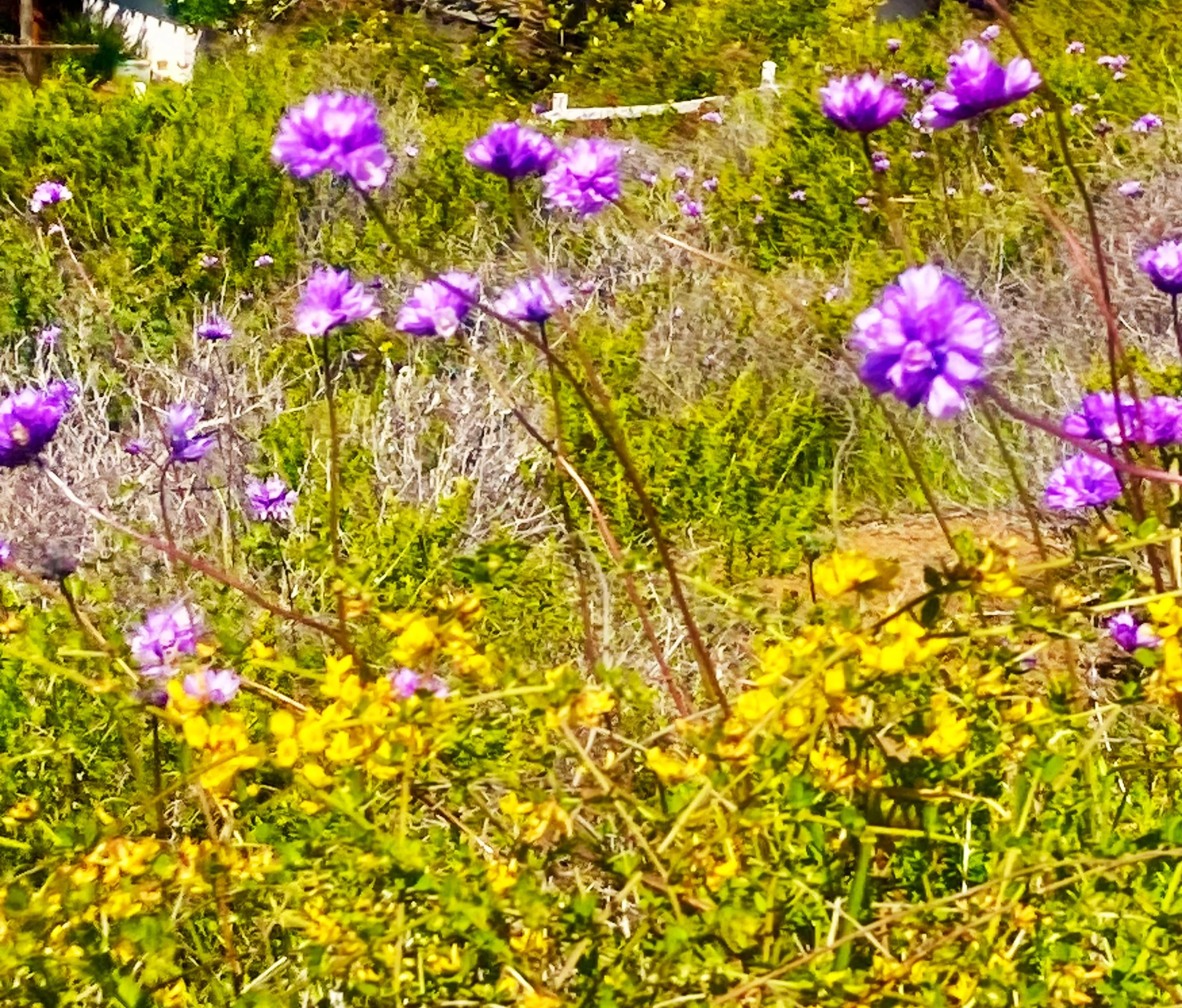
It’s just about impossible to photograph the whole plant. The flowers are isolated at the top of a super tall and thin stalk (scape), bracketed by only 2-3 grass-like leaves that droop to the sides.
How to Recognize Blue Dicks
In Punta Banda, you’ll find them blooming along the rugged coastal bluffs and in grassy openings within the coastal sage scrub. Because our peninsula is a high-biodiversity zone, Punta Banda provides the precise rocky, well-drained slopes that this species prefers.
Plant Characteristics
Stem & Leaves: It grows from a slender, leafless stalk (scape) that can reach heights of 6 to 24 inches. At the base, it usually has two to three long, grass-like leaves.
Flowers: The plant produces a dense, head-like cluster (umbel) of 2 to 15 small, funnel-shaped flowers. They range in color from pale blue to deep purple, and occasionally white.
The Corm: Underground, the plant grows from a corm (a starch-storing stem base), which plays a significant role in its survival and reproduction. Plants with this type of underground storage organ are classified as “geophytes,” plants that have evolved underground storage structures that allow them to survive environmental stresses. The common potato is another geophyte, as are the lovely Mariposa Lilies (Calochortus spp.) that you’ll see during the same season and habitat. Both are members of the asparagus family (Asparagaceae), which also includes asparagus and our local Shaw’s agave, another species of the month.
Because the corms are nutritious, they are attractive to many herbivores and omnivores, including humans. Some geophytes evolved toxins to repel those that would eat them. Others produce easily fragmented storage structures, the “bulblets” and “cormlets.” These often drop off the main corm during digging or eating and can then grow into a new plant.
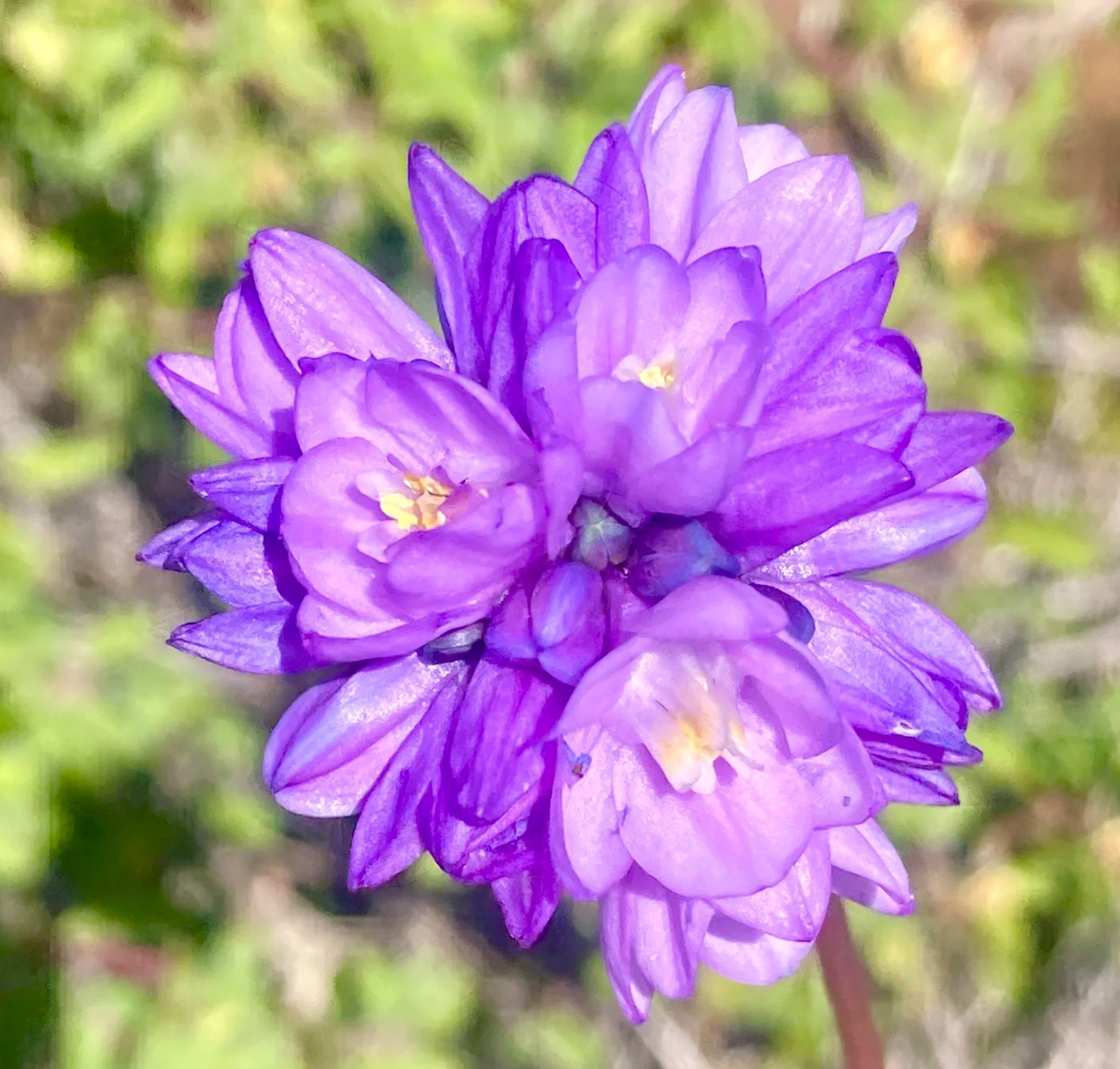
Here’s where the other other name, “Wild Hyacinth,” seems so much more fitting.
For the Kumeyaay and PaiPai, a Vital Source of Complex Carbs
Dichelostemma capitatum has a long history of use by Indigenous peoples here and across the West. The plant’s underground corms were a vital food source for the PaiPai and Kumeyaay people native to our region. Our dry, rocky landscape contains few calorie-dense native plants. Though small in size the corms of Dichelostemma are rich in complex carbohydrates. They were eaten raw, boiled, or most typically roasted in traditional pit ovens lined in rock. Roasted thus, the corms reportedly have a sweet, nutty flavor. These edible bulbs are called “Indian potatoes” and in the PaiPai language were grouped into a category translated as “earth foods.”
Native groups practiced a form of “wild tending” rather than passive foraging. They used sharpened digging sticks to pry bulbs from the rocky soil. While digging, they sometimes intentionally snapped off the tiny “cormlets” and replanted them in the loosened soil. This ensured that the patch of Blue Dicks would be even more productive the following year.
Coyote and the Good Children Eat Cacomites
One traditional story passed down by the indigenous Chumash people shows the importance of Blue Dick corms for native diets, and of children in helping to harvest foods and share nature’s bounty.
In this story, a very hungry Coyote comes across a group of children digging for cacomites, the Chumash word for Blue Dick corms. Some of these children are willing to share their bulbs with Coyote. These are the “good” children. But the stingy children will not share, saying, “Coyote, what I’ve dug is for my relatives only!” Coyote and the good children then take the bulbs to a different location to roast them. The cacomites of the generous children are roasted perfectly, while the bulbs of the stingy children burn, and they go hungry. Coyote and the good children enjoy their meal.
What to Do Next
It’s spring. Take a walk. Go for a hike. And when you come across a lovely Blue Dick swaying to the breeze, take a closer look. If you see a sturdy stick nearby, pick it up and dig up a corm. Take it home, wash it, and then taste it’s crisp sweetness. Or if you have more time, roast it first. And remember you’ll be doing our native habitat a favor. In return for the cacomite you harvest, the baby corms you leave behind will take root and grow into an even denser, prettier patch of Blue Dicks next season.