Reddish Egret: The Rarest North American Wading Bird (And we have them here in Punta Banda!)
If you’re wandering where the saltwater meets the marsh and you see a long-legged bird slightly larger than a Snowy Egret but with a reddish neck and a body shaded like a Great Blue Heron, take a closer look. Lucky for you, you may have just spotted the rarest and most charismatic wading bird species in North America: the Reddish Egret (Egretta rufescens). We are fortunate to host a vital foraging area for the Reddish Egret in our own Punta Banda Estuary. And local ornithologists say the population at the estuary appears to be growing!
Dancing for their Dinner
If you see one of these remarkable birds, watch for a few minutes and you will likely observe its distinctive foraging behavior, unique among North American egrets and herons. This is the most striking characteristic of Reddish Egrets we see at the estuary, and a tell-tale sign that it’s a Reddish Egret.
The Great Blue Heron is a lesson in stillness, waiting patiently until a fish approaches before striking with precision. Likewise, the Snowy Egret and Great Egret often appear as statues of tranquility, moving only at the decisive instant.
But the Reddish Egret lacks the patience of its cousins. Instead, it hunts through an active, energetic strategy. It runs through shallow water, spreads its wings, spins, lunges, and twists its neck in improbable directions. At first glance, the behavior appears chaotic, even comical but it is highly effective.
Small fish rely on camouflage and the distortion of light in shallow water to avoid predators. The egret’s erratic movements disrupt these visual cues, flushing prey and increasing capture success. What looks like disorder is, in fact, an evolved and efficient feeding technique.
How to Recognize the Reddish Egret
Its dance is the most sure-fire way of recognizing a Reddish Egret, particularly from a distance. But the Reddish Egret isn’t always dancing, so you’ll need other cues to recognize it. The Reddish Egret stands about 2½ feet tall and has a wingspan of roughly 46 inches. This is about the same size as a Little Blue Heron, and the Reddish Egret has the same blue-gray body and wings as the Little Blue Heron. But unlike the Little Blue Heron, the Reddish Egret has a reddish (of course), somewhat shaggy head and neck, and bluish legs. This may be difficult to distinguish from a distance or without the right light, so you might need to look closely. The species also occurs in entirely white plumage, although white ones are especially rare and difficult for inexperienced birders to distinguish from other white egrets.
If you’re really lucky, you may see a Reddish Egret in full breeding plumage, although they aren’t known to breed at the estuary (as described in the next section). When breeding, Reddish Egrets develop longer, shaggier, brighter, somewhat “unkempt” plumes on their heads and necks, with legs a brighter shade of blue than nonbreeding birds, and a salmon-pink bill tipped in black. This gives the bird a striking and somewhat wild appearance. Taken together, this egret is undeniably beautiful.
Local Seasonal Patterns and Distribution
Most observations of Reddish Egrets at the estuary have been juveniles and immature birds, and they’re most frequently seen in the late autumn and winter. This is because most adults tend to stay closer to their nesting colonies further to the south (primarily Baja California Sur), while young birds who aren’t yet tied to their breeding grounds often wander northward.
A colony of four Reddish Egret pairs was documented breeding on Todos Santos Island (one of the few breeding colonies in Northern Baja California) as late as 2008. This is the northernmost documented breeding colony of Reddish Egrets on the Pacific Coast. Birds on the island were nesting in velvet cactus (Bergerocactus emoryi), California encelia (Encelia californica), lemonade berry (Rhus integrifolia), and desert thorn (Lycium species). This habitat differs from the mangrove dominated habitat further south where breeding birds are most abundant, and their preference for mangroves may be one reason the species nests primarily in Baja California Sur.
Over the past five years, local ornithologists have reported an increase in Reddish Egret observations at the estuary during the breeding season, but with no confirmed breeding there. These breeding-season birds may be flying from a breeding site on Todos Santos Island, as was observed in 2008. The increase in observations in the estuary over recent years may indicate that the breeding population on Todos Santos Island has grown, although this hypothesis remains unconfirmed as no published breeding surveys have been conducted on the island since 2008.
Whether you find them in breeding plumage or not, the birds' dancing would be the highlight of any trip to the estuary. And if you do see them in breeding plumage, please report it by calling or texting El Berryman at (530) 798-1945, preferably with photos.
Its Beauty Nearly Killed It
The Reddish Egret isn’t simply reddish. In direct sunlight, its head and neck feathers may glow like rusted flame while its body appears slate gray. As the light shifts, tones can seem to change from copper to wine, from steel to smoke. This effect is not due to a special feather structure, but rather to complex feather pigmentation and the way light interacts with layered plumage.
Its plumes are so striking that in the late 1800s the Reddish Egret was driven to near extinction as plume hunters collected feathers for the women’s hat trade. Although populations have partially recovered, the species remains rare. Current estimates suggest roughly 5,000 breeding pairs globally.
Confined almost entirely to North and Central America, the Reddish Egret has one of the most limited ranges and smallest populations of any North American heron species. And we are fortunate to have them here in our Punta Banda estuary.
Decline and Conservation
The Reddish Egret is among the rarest, most vulnerable, and least studied of the more than 30 species of herons and egrets (family Ardeidae) in the Americas. Climate change, rising seas, and shifting coastlines threaten to redraw the map of its survival.
The increasing number of breeding-season Reddish Egrets at Punta Banda Estuary (probably nesting on the island) may be a result of shifting distribution due to climate change. The Reddish Egret’s range is extending northward as evidenced by increasingly common non-breeding visitors in San Diego County. The ranges of many bird species are shifting northward as the climate changes, as they seek temperatures to which they’re accustomed. With this shift, birds may move into less favorable habitat (e.g., different vegetation providing different nesting material and cover) which may diminish their reproductive success.
Reddish Egrets are largely confined to narrow belts of coastal habitat, particularly coastal lagoons and tidal flats in southern Texas and Florida, along Pacific Mexico and Central America, and the Gulf of Mexico, the Caribbean, and the West Indies. These edge habitats are shrinking.
Mariculture, shipping, industrial expansion, coastal development, recreational disturbance, sea-level rise, and environmental contamination all threaten the tidal flats and lagoons on which the species depends. These habitats are being drained, dredged, altered, and built over. The bird cannot simply move inland; it is tightly bound to specific coastal ecosystems.
In the United States, the U.S. Fish and Wildlife Service has designated the Reddish Egret as a species of conservation concern. In Mexico, it is listed under NOM-059-SEMARNAT-2010.
written by Cindy Berryman
See for Yourself!
The Punta Banda Birding Club meets once every month to birdwatch around Punta Banda and he spend a lot of time around the estuary. If you’re interested in joining us, and perhaps spotted one of these rare, dancing egrets, text or call El Berryman at (530) 798-1945 and we can add you to our WhatsApp group.
For more information on Reddish Egrets, including identification tips and a video of them dancing, visit their page on the Cornell Lab of Ornithology.
(more photos below)
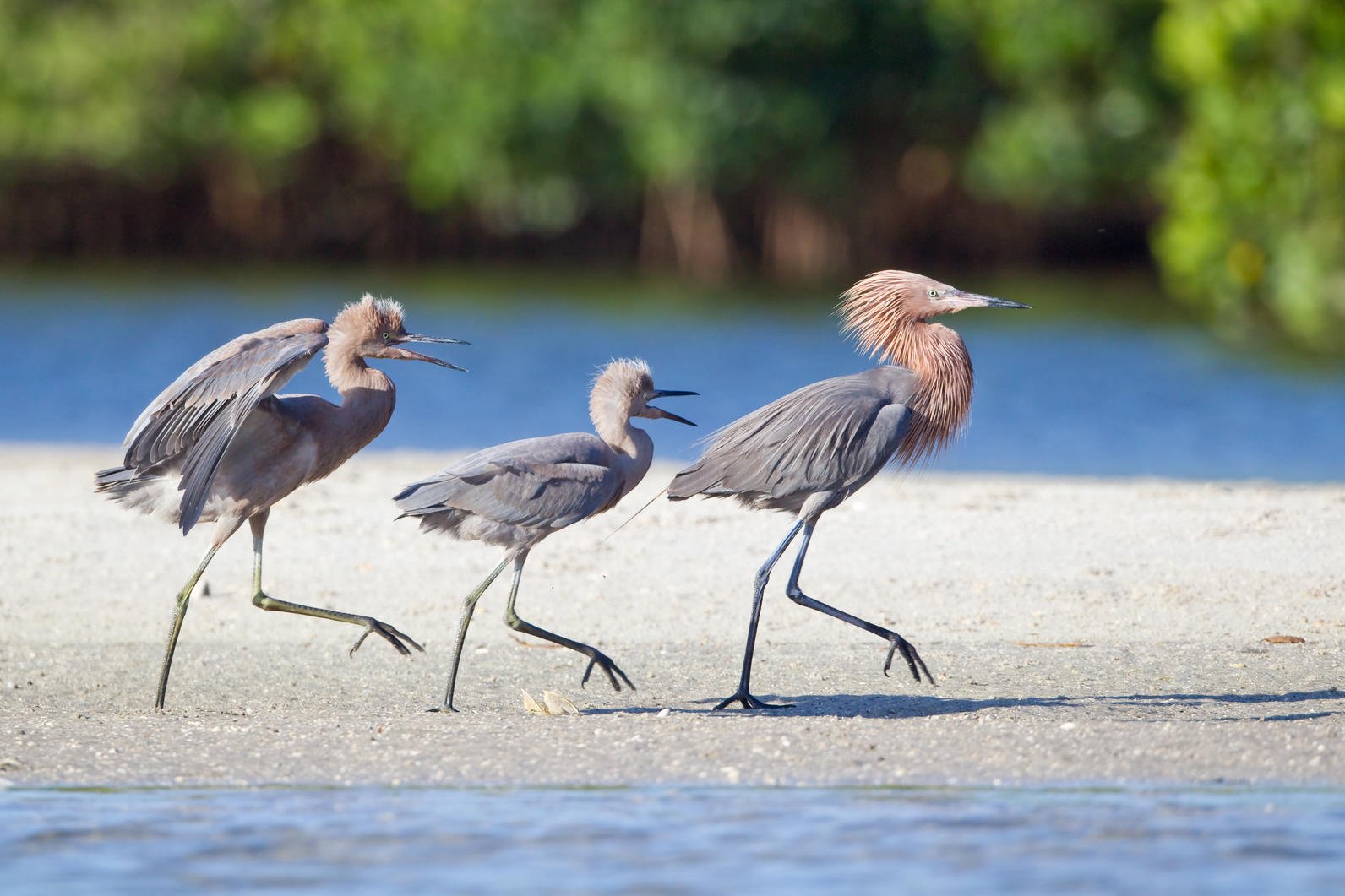
Mama and chicks. Taken in Texas, in their typical breeding habitat with mangroves.
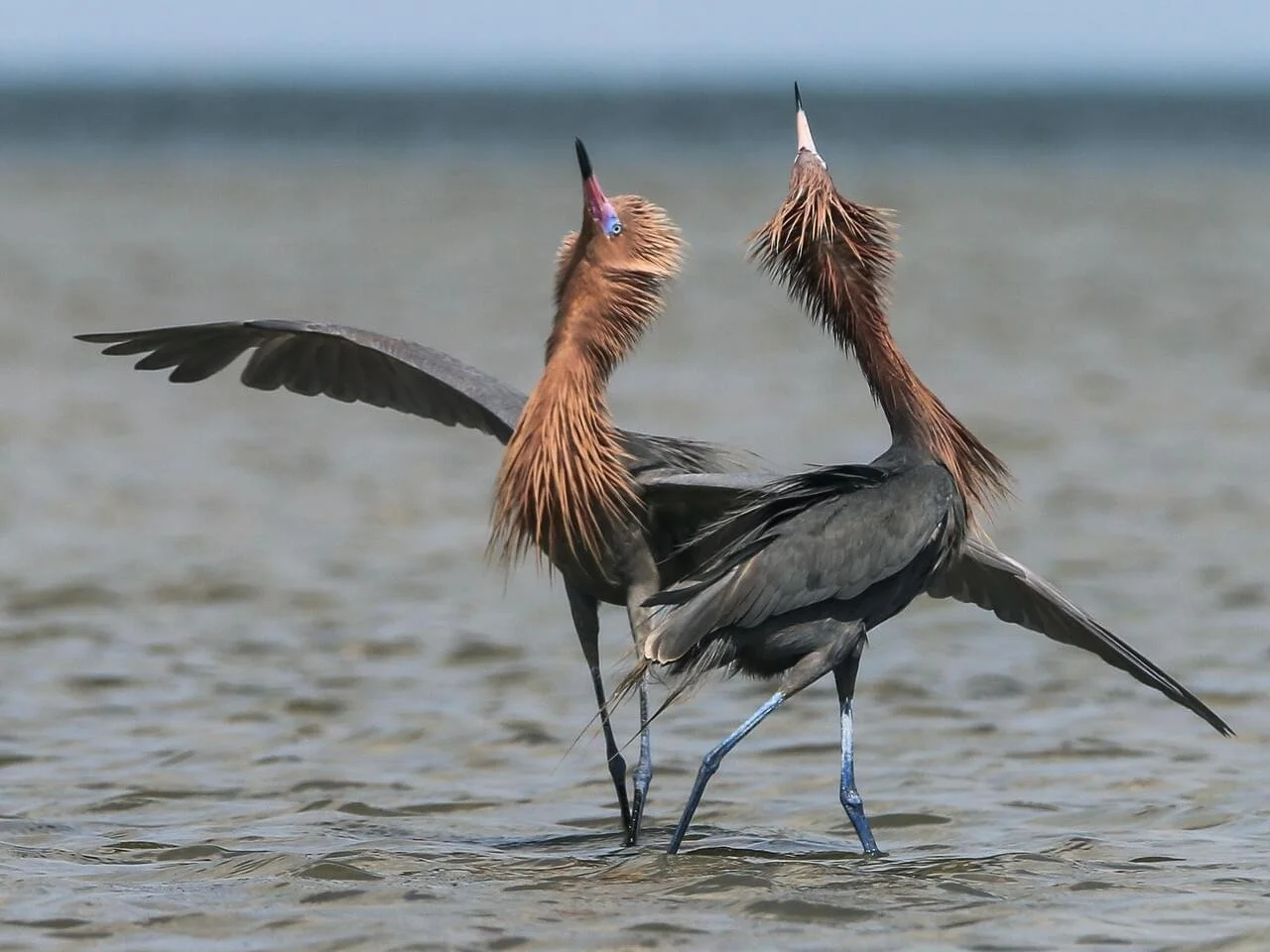
Mating dance. Now those are shaggy necks! Texas.

Reddish Egret “spread eagle” as he dances for his dinner. Punta Banda Estuary, non-breeding plumage.

Statuesque Common Egret observes the Reddish Egret’s fishing antics. Punta Banda estuary.
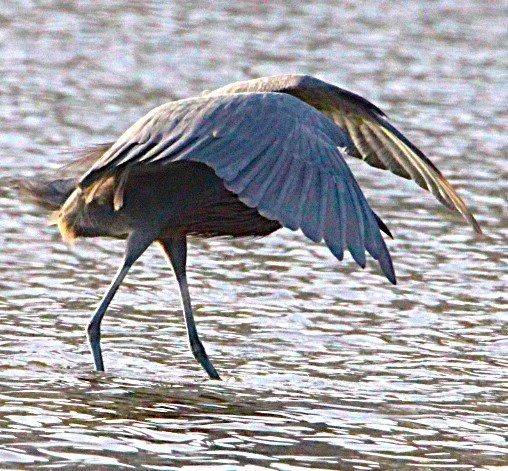
Canopy feeding. By spreading their wings over their heads like an umbrella, they reduce surface glare to spot small fish, while simultaneously creating shade that lures prey into striking range. Punta Banda Estuary
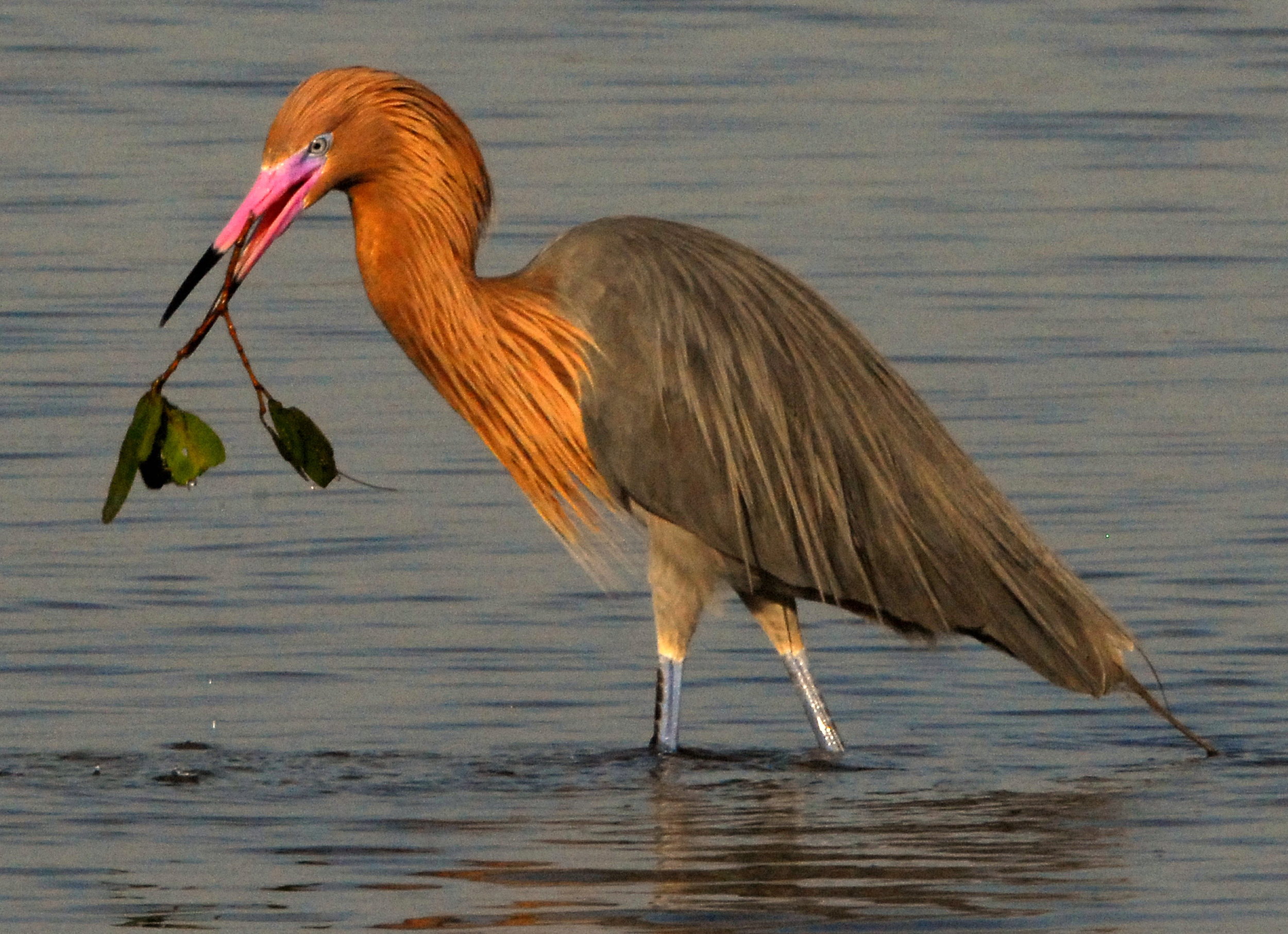
Breeding plumage. This breeding adult is particularly striking. Note the shaggier neck and body, and the pink bill with a black tip. It’s carrying a mangrove twig, probably to build a nest. The photo is from southern climes where mangroves are prominent.

Plume hunters for fancy hats nearly drove Reddish Egrets to extinction in the late 1800s
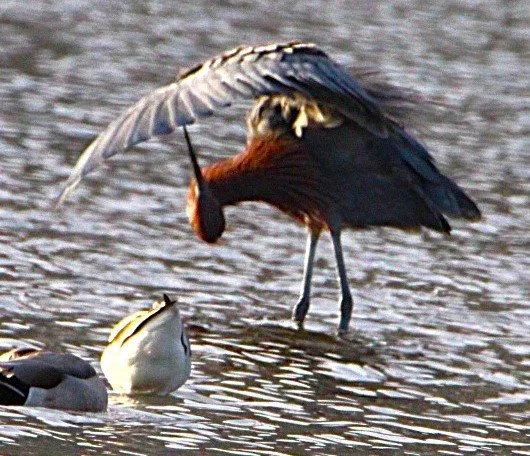
Mid-dance with his neck in an improbable direction. Non-breeding. Punta Banda Estuary.

Punta Banda Birding Club

In for the kill. Non-breeding. Punta Banda Estuary.